
Vehicle-specific brake upgrade guide
How to Choose a Big Brake Kit That Fits Your Car and Wheels
Which big brake kit fits my car, and will it clear the wheels I already own? Two checks answer both questions. First, confirm that the kit matches your vehicle and axle. Then check the proposed caliper and disc against the inside of your wheels. The wheel’s advertised diameter alone cannot settle the second check.
We can review both with you. Send your vehicle and wheel details through our fitment inquiry form. Our technical team will identify the proposed configuration, provide the drawing for that setup, and tell you which minimum clearances apply.
Your path to a decision: Measure your wheels → send an inquiry → review the proposed kit and drawing → check wheel clearance → order the confirmed configuration.

Start with a five-minute wheel check
You can gather useful information before choosing a kit. This first check helps identify an obvious conflict and gives our technical team a better starting point. Remove the wheel before measuring it.
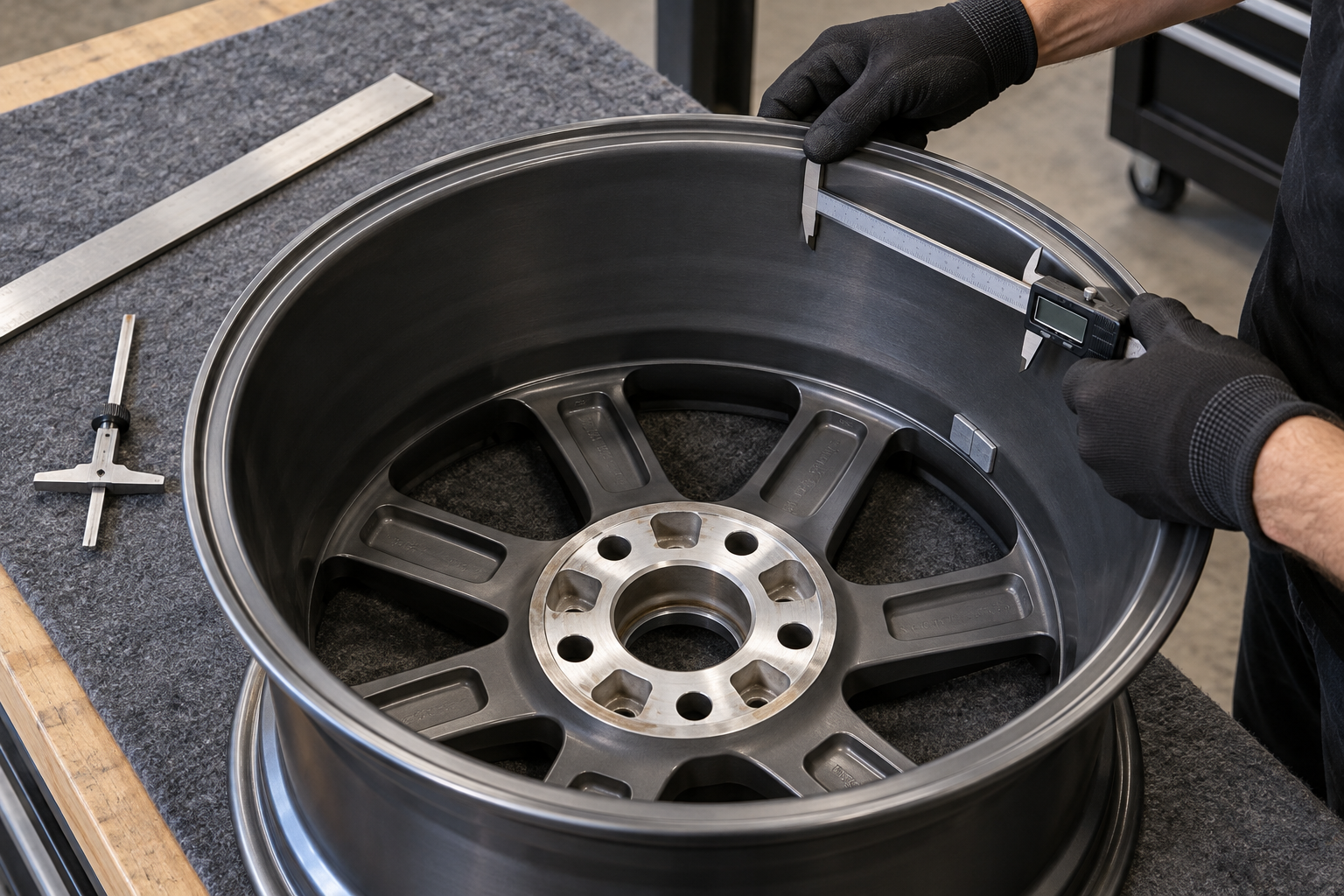
- Full wheel specification: record brand, model, diameter, width, offset (ET), and any marking that identifies its version. Record front and rear separately if they differ.
- Inner barrel: measure the usable inside diameter at the narrowest relevant sections, including the area where the proposed brake assembly will sit. A wheel marked “19 inch” does not have a uniform 19-inch opening inside.
- Spoke depth: measure from the wheel’s mounting face toward the back of the spokes at several distances from the center. The closest point may be away from the spoke’s center.
- Local obstructions: note balancing weights and any wheel feature projecting into the brake assembly’s space.
If the barrel’s inner diameter at the proposed disc position is smaller than the disc’s outside diameter, that combination has an obvious conflict. A larger barrel measurement clears only this first hurdle: the caliper extends beyond the disc, and barrel shape and spoke position still need checking.
Narrow the kit choice by vehicle, use, and axle
Start with the exact vehicle: make, model, year, chassis or trim, and original brake specification. Include the VIN if available, along with changes to the hubs, suspension, or existing brakes. The ICOOH big brake kit range is a starting point; your inquiry establishes which configuration applies to your car.
Describe how you use the car in plain terms. These sentences can be copied into your inquiry:
“This is my daily driver. I want to keep the current wheels and improve braking for occasional mountain-road driving.”
“The car does several track days each year. Please review the proposed disc and pad setup for that use.”
“I want a front-axle upgrade only. Please confirm how it works with my current rear brakes.”
State whether you want a front kit, rear kit, or both. For a rear upgrade, include the parking-brake type and relevant modifications. Mechanical and electronic parking-brake arrangements may require different solutions.
The IC6 front brake kit page illustrates why a product series is only the beginning of the choice: it lists 380, 390, and 410 mm disc options and describes the series as suitable for 19-inch wheels and above. Your vehicle, chosen disc, caliper position, and actual wheel shape determine the configuration to check.
Request the drawing for the proposed configuration
Send your vehicle details, intended axle, use, wheel specifications, measurements, and photographs through our fitment inquiry form.
Keep the configuration details together: kit or part number, axle, caliper, disc diameter and thickness, mounting arrangement, and drawing revision. Changing the disc size or caliper can change the clearance check even when the vehicle and wheels stay the same.
A drawing may cover more than one vehicle when the brake assembly sits in the same position relative to the wheel mounting face. EBC explains that its Mazda RX8 and MX5 NC applications can use the same wheel-clearance template for this reason, although the brake kits differ. Match the drawing to the configuration confirmed in your inquiry rather than choosing one from a vehicle name alone. See EBC’s shared-template explanation.
If we provide a printable template
Use the instructions supplied with that file. A typical physical check follows these steps:
- Print at actual size or 100%, with fit-to-page scaling turned off.
- Check the printed reference dimensions in both directions with a ruler.
- Mount and cut the template as instructed. Use its center-opening and wheel-mounting-face references to position it correctly.
- Place it inside the wheel and check the relevant barrel and spoke areas.
- Measure and photograph the smallest gaps, including areas near balancing weights.

Wilwood’s drawing for kit 140-18123 gives a concrete example: it instructs users to verify a 1:1 print against both axes, mount the sheet on cardboard, and cut it using the measured wheel center-opening diameter. Wilwood notes that actual parts may vary and calls the drawing a general fitment guide.
If we provide a 3D or CAD file
Ask us how to check its dimensions against your wheel, or have a qualified shop perform the comparison. If you cannot print the drawing we send, do not resize a screenshot to approximate a physical template.
Check the barrel, spokes, and balancing weights
A brake assembly needs space in more than one direction. Inspect these areas separately:
| Area | What to check |
|---|---|
| Inner barrel | Space around the outer edge of the caliper throughout the relevant barrel profile. |
| Spoke backs | Space between the caliper’s outward face and the back of each spoke at the caliper’s position. |
| Balancing weights and local features | Space where an added weight or wheel feature projects toward the brake assembly. |

A wheel can clear the barrel and still contact a spoke. AP Racing identifies the inner spoke area as a common interference point. Even wheels with the same advertised diameter, width, and offset can have different spoke and barrel shapes. AP Racing’s inner-wheel-clearance guidance and EBC’s wheel-fitment guidance explain these checks.
If the drawing or checking profile touches the wheel, record the contact location and send photographs to our technical team. Pause the purchase decision until the combination has been reviewed. Do not add a spacer or remove material from the wheel or caliper just by eye.
How much clearance is enough?
Use the minimum gap specified for your exact brake configuration. Published figures show why a single number cannot be applied to every big brake kit. Wilwood’s kit 140-18123 drawing requires at least 0.080 inch (about 2.03 mm) between the wheel and caliper in all areas. EBC’s guidance requires 5.0 mm from the caliper to both the spokes and inner barrel for the kits it covers.
Those figures belong to those manufacturers’ products. For an ICOOH setup, the required gap depends on the vehicle, caliper, disc size, and mounting arrangement. Read the value and its measurement locations on the drawing or in our technical response for your configuration. Neither 2.03 mm nor 5.0 mm is a universal big brake kit standard.
Wheel clearance is one part of the installation check. After installation, the shop should check brake clearance to surrounding components through the applicable suspension travel and steering range before the vehicle is driven. EBC’s installation guidance explicitly calls for full suspension travel and lock-to-lock steering checks for its kits.
Decide what your result means
| Your result | Next action |
|---|---|
| You have the drawing for the confirmed configuration, and the recorded gaps meet its requirements. | Send the measurements and photographs to our technical team with the drawing revision so the checked combination can be recorded and confirmed. |
| The drawing touches the wheel, or a measured gap falls below its stated requirement. | Send the contact location and measurements to us. Ask for a different configuration or wheel option before ordering. |
| You do not yet have a drawing or the required gap for the proposed setup. | Submit wheel measurements and photographs through the inquiry form. Wait for the configuration-specific checking method and technical response before ordering. |
A vehicle match and a wheel-clearance result should be identified separately. When a combination is described as verified, its record should identify the vehicle and axle, exact kit configuration, wheel model and specification, and the evidence used—such as the configuration drawing with measured gaps or a matching documented installation. A vehicle listing is the starting point for this check.
Copy this record into your inquiry
| Fitment record | Your details |
|---|---|
| Vehicle, year, chassis/trim, VIN | ____________________ |
| Front or rear axle | ____________________ |
| Intended use | ____________________ |
| Current brake or hub modifications | ____________________ |
| Wheel brand, model, size, width, and offset | ____________________ |
| Proposed kit, caliper, disc diameter and thickness | ____________________ |
| Drawing reference and revision | ____________________ |
| Smallest barrel gap and location | ____________________ |
| Smallest spoke gap and location | ____________________ |
| Balancing-weight position and gap | ____________________ |
| Photographs supplied | ____________________ |
| Technical response and confirmed configuration | ____________________ |
This is a blank recording format, not a verified installation case.
Frequently asked questions
Will any 18-inch or 19-inch wheel fit a big brake kit advertised for that size?
Wheel diameter alone cannot confirm fit. Check the barrel profile and spoke backs using the drawing for the proposed kit. Wheels with the same nominal size can provide different internal clearance.
Can I add a wheel spacer if the caliper touches a spoke?
Send the interference measurements and photographs to our technical team first. A spacer changes the wheel’s installed position and introduces other fitment considerations. AP Racing advises against using a spacer or removing material as a cure for interference in its applications; the solution for your proposed setup needs its own review. Read AP Racing’s guidance.
What if my front and rear wheels are different?
Record and photograph both specifications. Check each proposed axle and brake configuration against the wheel fitted at that position.
What if my wheel manufacturer does not offer a brake-clearance template?
Remove the wheel and provide its inner-barrel measurements, spoke-depth measurements, and the photographs listed above. Our technical team can then tell you what further information or checking method is needed for the proposed brake configuration.
Ready to check your setup?
Send us your vehicle and wheel details
We will use your record and photographs to identify the vehicle-specific configuration, provide its drawing and minimum gaps, and tell you which measurements remain to be checked.
Send a fitment inquiry →