
A practical guide to heat, brake pads, rotor
Brake Systems 101 · Buying Guide
Street vs. Performance vs. Track Big Brake Kits: What Should You Buy?
Choose a brake setup for the driving you actually do. For daily road use, start with the street-focused CS100 pad. If repeated braking on highways or mountain roads is your concern, consider CS200. For track days, ICOOH’s confirmed IC6 and IC10 configuration pairs the appropriate carbon-ceramic discs with CS400; CS450 is the option aimed at endurance racing. Choosing between the IC6 and IC10 caliper kits is a separate fitment decision based on your vehicle and wheels.
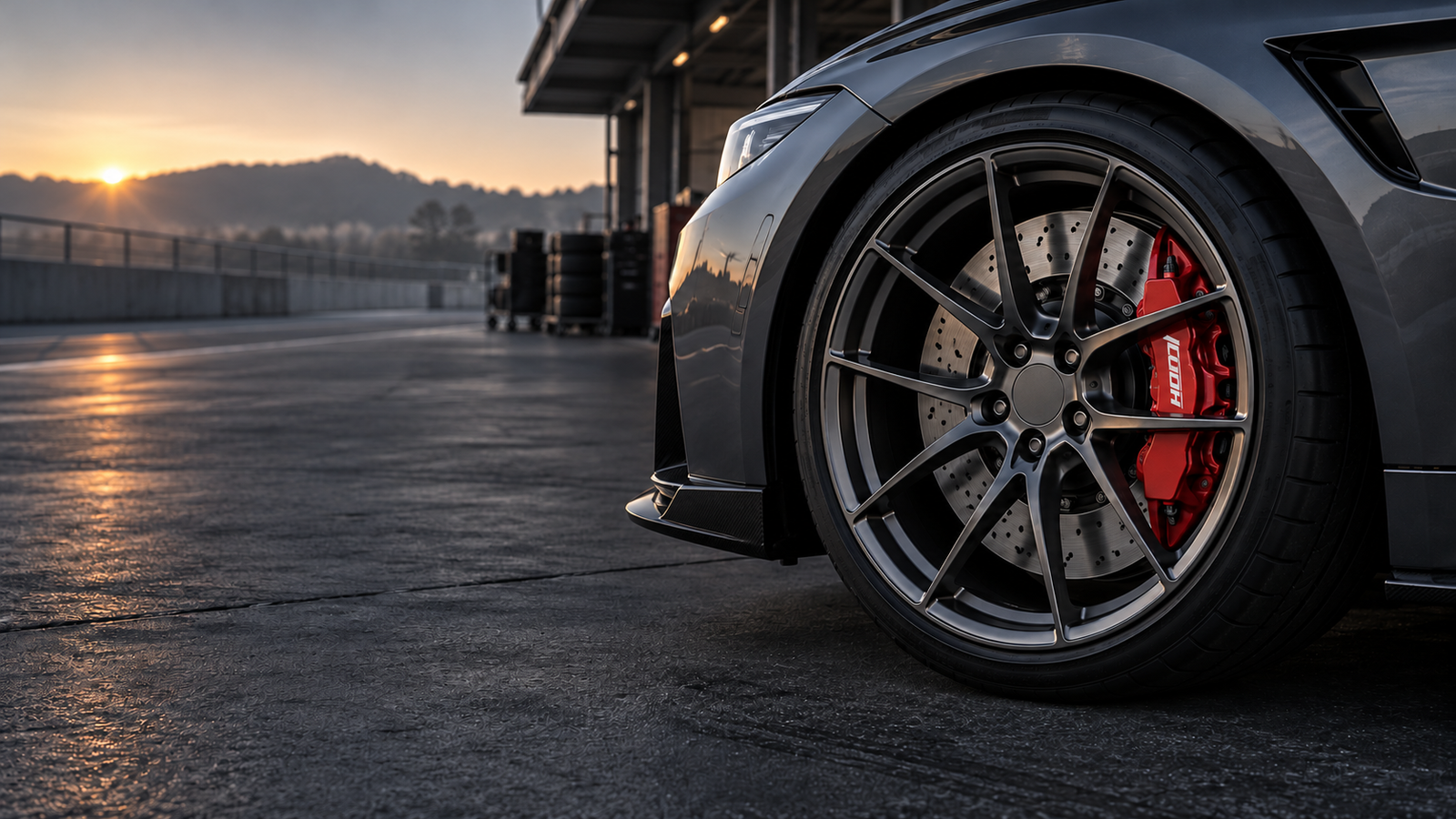
The short answer: Street, performance and track setups differ mainly in the heat they are designed to manage, the friction materials they use, and the compromises a driver accepts. A larger caliper alone does not turn a road setup into a track setup. The disc, pad, fluid, tires and installation must work together.
Why Heat Changes the Answer
When you brake, friction converts the car’s kinetic energy into heat. A single stop from road speed may feel perfectly controlled, yet repeated stops on a descent or during a track session can raise the temperature of the discs, pads and fluid. That is why a brake system that feels adequate in traffic may behave differently after several hard braking zones.
Three related ideas help explain the difference. Heat capacity describes how much energy a component absorbs for a given rise in temperature: with greater heat capacity, the same absorbed energy produces a smaller temperature increase. Heat dissipation is the system’s ability to transfer heat to its surroundings. High-temperature performance asks whether the disc-and-pad pairing and brake fluid continue to do their jobs after they become hot. A complete setup must address all three.
The symptoms can also point to different problems. If the pedal remains firm while the car becomes harder to slow after repeated stops, the pad may be operating outside the temperature range in which it provides the needed friction. If the pedal becomes unusually long or soft, inspect the hydraulic system and fluid; boiling fluid can form compressible vapor. Neither symptom should be diagnosed from a product label alone. Stop driving hard and have the system checked before continuing.
ICOOH Street, Performance and Track Configurations
The table below describes ICOOH’s confirmed IC6/IC10 configuration plan. It is a product-specific guide, not an industry-wide grading system.
| Decision point | Street | Performance road | Track day | Endurance racing |
|---|---|---|---|---|
| ICOOH pad | CS100 | CS200 | CS400 | CS450 |
| Published use | Street | Highway and mountain roads | Track days | Endurance track racing |
| Published operating range | 0–450°C | 0–550°C | 100–900°C | 100–1100°C |
| Published average friction coefficient | μ 0.30 | μ 0.40 | μ 0.56 | μ 0.57 |
| Dust / noise | Low / low | Low / low | High / high | High / high |
| Bedding requirement | Minimal bedding required | Minimal bedding required | Bedding required | Bedding required |
| Disc pairing in this ICOOH plan | Vehicle-matched road configuration | Vehicle-matched road configuration | Corresponding IC6/IC10 carbon-ceramic disc | Corresponding IC6/IC10 carbon-ceramic disc |
ICOOH brake-pad specifications are selection data, not stopping-distance tests. Operating ranges and average friction coefficients do not, by themselves, establish cold-pedal feel, real-world braking distance or suitability for every vehicle. Confirm the exact disc, pad and vehicle application before ordering.
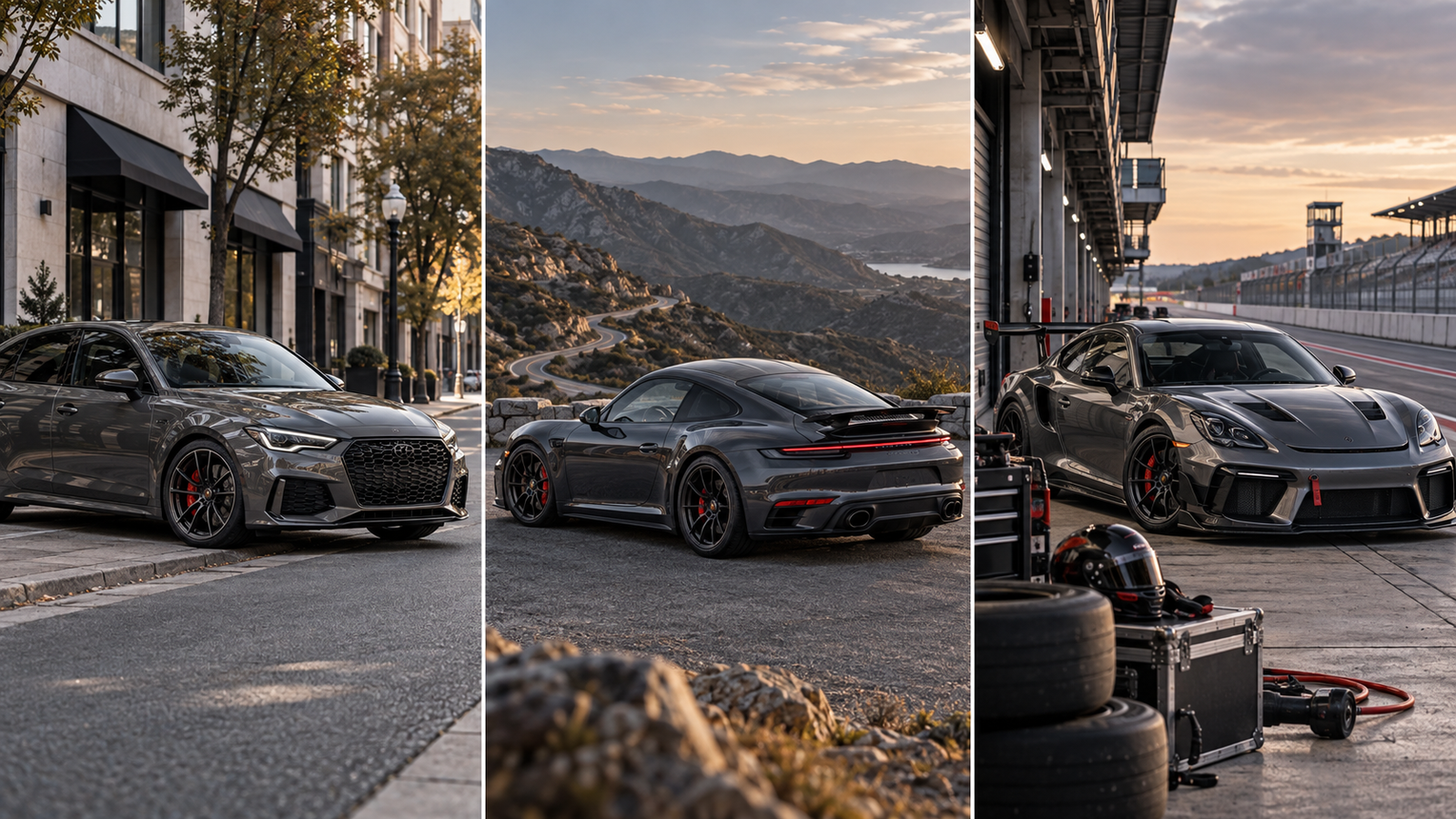
Which Setup Fits Your Driving?
CS100: You drive on the road and do not plan track days
If the car is used for commuting, errands and ordinary road trips, the CS100 street configuration is the starting point. ICOOH lists it for street use with low dust and low noise. Paying for a track-focused pad in this case adds compromises that you may notice every day while leaving its high-temperature capability unused.
A larger brake kit can still make sense for a road car when the existing hardware has a verified fitment, thermal or service limitation. First identify that limitation. If the brakes work consistently and your main request is a different appearance, be clear that the purchase is also an aesthetic choice.
CS200: You repeatedly ask more of the brakes on the road
Consider CS200 when your normal use includes long descents, frequent higher-speed braking, a heavier vehicle or sustained mountain-road driving. ICOOH positions it for highway and mountain-road use and publishes a wider operating range than CS100, while listing both as low-noise and low-dust options.
The useful question is whether your driving regularly creates enough repeated heat to justify the change. For example, an SUV carrying passengers and luggage down a long grade faces a different duty cycle from the same vehicle commuting across town. If you are seeing repeatable changes in braking behavior, document when they occur and have the current pads, fluid and hardware inspected. CS200 is a road-performance choice; ICOOH’s pad chart does not designate it for track use.
CS400 or CS450: Your plan includes circuit driving
A track session combines repeated high-energy stops with short recovery time. Heat accumulates faster, and a road pad may lose the friction behavior needed at those temperatures. That is the engineering reason to change the friction system for track work; the CS200 “no track use” label is consistent with this difference in duty cycle, rather than being the only reason to avoid it.
For ICOOH IC6 or IC10 track applications, select the corresponding carbon-ceramic discs and CS400 pads for track days, or CS450 pads for endurance racing, subject to application confirmation. These are matched configurations, not an instruction to fit a track pad to an arbitrary disc. Expect a different ownership trade-off: ICOOH lists higher dust and noise and requires bedding for both track pads.
The track choice depends on more than how often you visit a circuit. Vehicle mass, speed, tire grip, circuit layout, session length and driving style all change the brake’s workload. If you attend one short introductory session, describe the exact event and vehicle to the supplier. If you run repeated long sessions or endurance events, ask about disc and pad life, cooling, inspection intervals and spare parts before choosing the kit.
IC6 vs. IC10: Choose the Hardware After You Choose the Use Case
CS100, CS200, CS400 and CS450 describe pad choices. IC6 and IC10 describe caliper-kit families. A ten-piston caliper is not automatically the right upgrade for a driver who needs more heat capacity. Caliper piston area, disc dimensions, wheel clearance and the vehicle’s hydraulic and brake-balance requirements must be checked as a system.
ICOOH lists the IC6 as a six-piston front kit with 380, 390 and 410 mm disc options, generally aimed at wheels of 19 inches and above. The IC10 range is positioned around a ten-piston front caliper and larger 400, 420 and 440 mm disc options for selected vehicles with 20–22-inch wheels. Those wheel-size figures are product positioning, not a clearance guarantee.
A practical way to decide
First, state the vehicle, year, wheel model and use case. Next, identify the compatible IC6 or IC10 application and verify physical wheel clearance. Then choose the road or track disc-and-pad pairing. This order prevents piston count or visual size from driving a purchase before fitment is known.
Brake Fluid and Bedding: Two Steps You Cannot Skip
Choose brake fluid by specification and use, not by the DOT number alone
Glycol-based DOT 3, DOT 4 and DOT 5.1 fluids absorb moisture over time. As moisture content rises, boiling resistance falls. If fluid boils during hard use, vapor can compress and the pedal may become long or soft. Silicone-based DOT 5 is a different category and must not be treated as an interchangeable “higher number.”
- Check the vehicle manufacturer’s required fluid specification and service instructions.
- Compare the candidate fluid’s published dry and wet boiling points. “Wet” is a standardized test condition after controlled moisture exposure, not a reading from your car.
- Confirm compatibility with the vehicle, seals and brake-system components.
- Agree on a replacement and inspection schedule suited to the driving you do.
Higher published boiling points can be useful when repeated braking heats the system, but they do not repair old fluid, trapped air or a mechanical fault. Have those conditions inspected before relying on a new fluid grade.
Plan bedding before the first demanding drive
Bedding prepares the pad-and-disc interface for use. Depending on the friction material, the process can involve establishing a suitable contact surface and, in some cases, a transfer layer and controlled heat cycles. One universal “number of stops” is not appropriate for every compound or disc.
Obtain the instructions for the exact ICOOH disc-and-pad combination before installation. Decide whether the installer or owner will carry out the procedure, where it can be done safely, and how completion will be checked. Before the first road or track outing, confirm correct installation, fluid condition, pedal behavior and any required post-bedding inspection. Track-use CS400 and CS450 should not go straight from installation into a full session without the specified preparation.
Three Ways Buyers Spend More Without Solving the Problem
1. Buying a BBK to guarantee a shorter single-stop distance
Tires ultimately transmit braking force to the road. If a vehicle can already reach the tire’s grip limit on one stop, larger hardware alone cannot promise a shorter distance. The more relevant BBK benefits may be thermal headroom, repeated-stop consistency, service capacity and pedal response. If traction is the limiting factor, tire choice and condition deserve attention first.
2. Choosing the largest caliper before identifying the bottleneck
More pistons are not a universal ranking of braking performance. A kit must suit the master cylinder, vehicle mass, intended disc, wheel and front-to-rear brake balance. Start by inspecting the current pads, fluid, discs and tires. A road car with worn fluid or unsuitable pads may not need the cost of a complete kit to solve its immediate problem.
3. Treating a track pad as a premium street pad
CS400 and CS450 serve demanding track applications and are listed with high dust, high noise and required bedding. If the car never sees sustained track temperatures, you pay for capability you do not use and accept its day-to-day trade-offs. CS100 or CS200 is usually the more relevant place to begin for road-only driving.
What to Confirm Before You Order
A correct brake choice has to fit the actual vehicle, not just the model name on a product page. Send the supplier the following information before paying for hardware:
- Vehicle details: make, model, model year, trim, drivetrain and any existing brake or suspension modifications.
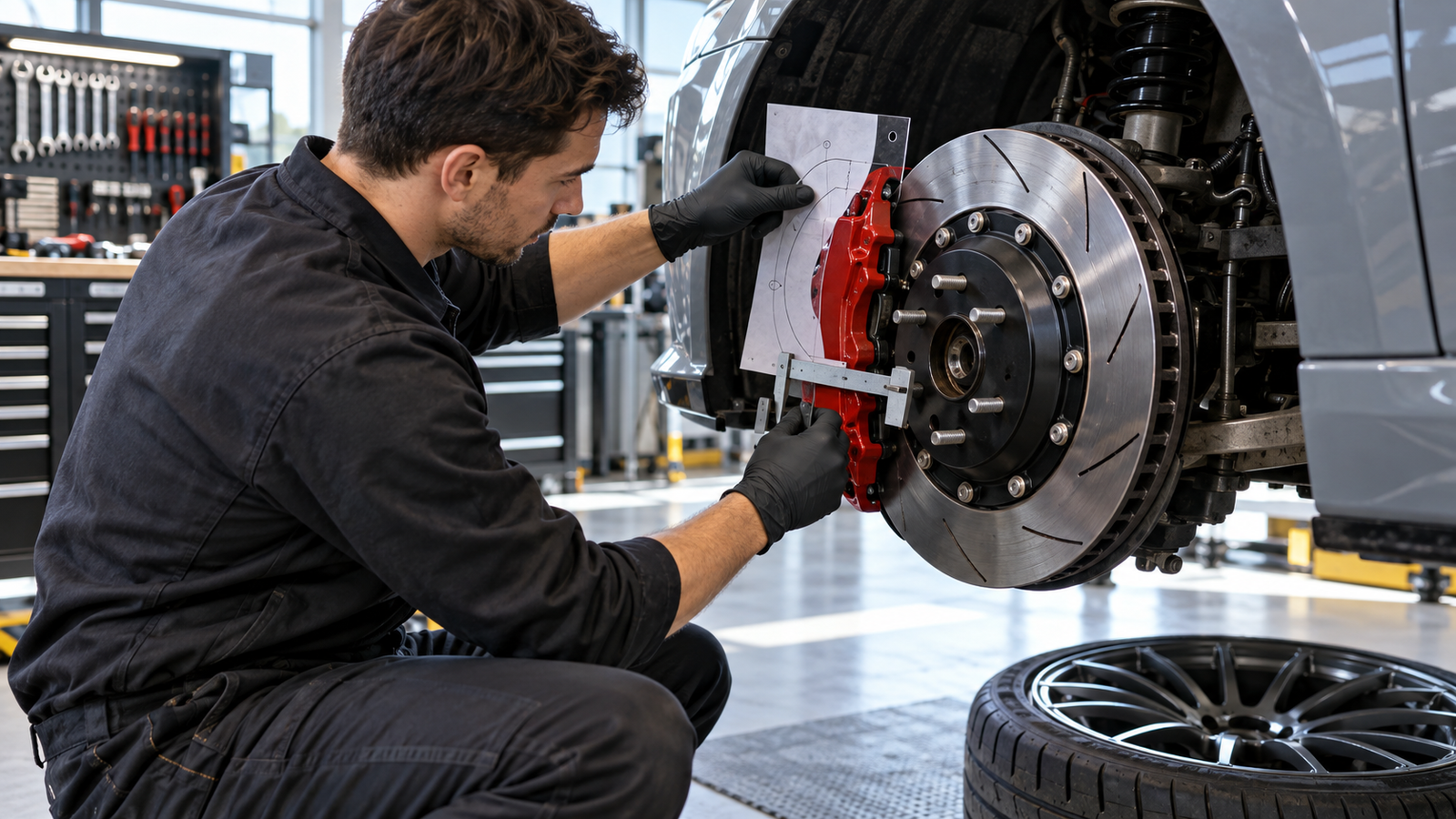
- Wheel details: diameter, width, offset, wheel model and whether spacers or aftermarket wheels are used. Ask for a fitment template or measured clearance check; nominal wheel diameter alone is insufficient.
- Driving pattern: ordinary road use, repeated mountain descents, track-day session length or endurance use.
- Complete configuration: IC6 or IC10 application, disc material and dimensions, CS pad compound, fluid specification, hydraulic compatibility and front-to-rear balance.
The installer should also confirm hose routing through steering and suspension travel, bracket and fastener requirements, wheel-to-caliper clearance and the bedding procedure. These checks are especially important when wheels or other brake components have already been changed.
Frequently Asked Questions
Do big brake kits make a difference?
They can when the current system is limited by repeated heat, component capacity or an application-specific hardware constraint. The useful difference is often consistency across repeated stops. The benefit depends on the complete vehicle setup and the problem you are trying to solve.
Do big brake kits stop a car faster?
They can improve braking behavior in some conditions, but a kit does not guarantee a shorter single-stop distance. Tire grip, road surface, vehicle systems and the existing brakes all affect the result. Repeated hard stops are where added thermal capability may become most useful.
Should I choose CS100 or CS200 for road use?
Start with CS100 for normal street driving. Consider CS200 if long descents, heavy loads or repeated higher-speed road braking are a regular part of your use. Both are road-focused choices in ICOOH’s published pad chart; neither is designated for track use.
Can I use CS200 for occasional track days?
ICOOH’s published pad chart marks CS200 as unsuitable for track use. For an IC6 or IC10 track application, confirm the matching carbon-ceramic disc and CS400 track-day pad configuration. Describe the car and event to the supplier before ordering.
Can I choose CS400 or CS450 without changing the disc?
For the ICOOH IC6/IC10 track configuration described here, no. The confirmed pairing uses the corresponding carbon-ceramic discs with CS400 or CS450. Disc and pad compatibility must be verified together for the exact vehicle application.
Do new brake pads and discs need bedding?
Follow the instructions for the exact components installed. ICOOH lists minimal bedding for CS100 and CS200 and required bedding for CS400 and CS450. Get the procedure before installation and complete it before demanding use.