
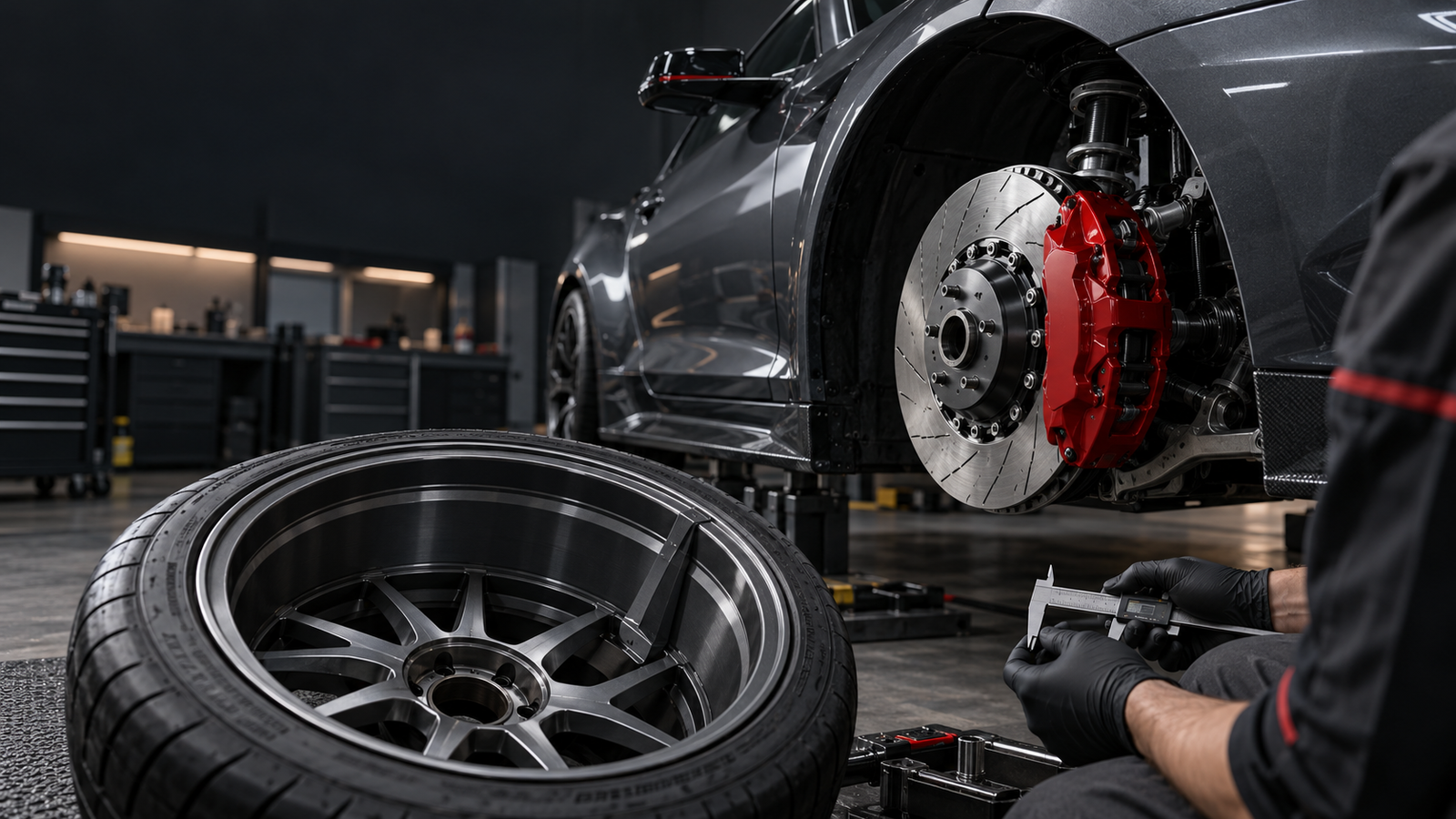
Is a 10-piston brake kit automatically better than a 6-piston kit? If you already plan to upgrade your brakes, it is reasonable to ask whether more pistons deliver something you will use—or simply raise the price.
Piston count describes the caliper’s layout. To choose a kit, you also need to know the piston sizes, rotor and pad specification, which axle the kit serves, and whether it fits your vehicle and wheels. A higher count may be part of the right solution, but it cannot answer those questions for you.
This guide helps you narrow the choice. Start with your vehicle and the braking problem you want to solve, use your existing wheels to screen possible kits, then send the proposed configuration through our modulo di richiesta di montaggio for a vehicle and clearance check.
What does “4, 6 O 10 pistons” tell you?
In a typical fixed opposed-piston caliper, pistons sit on both sides of the rotor and push the pads toward it. A 4-piston caliper commonly has two pistons on each side, a 6-piston caliper has three, and a 10-piston caliper has five.
The pistons do not have to share one diameter. Nostro IC6 product specifications list three six-piston variants:
| IC6 variant | Published piston diameters | Area used for comparison in this guide |
|---|---|---|
| IC61 | 31.8 mm × 2; 36.1 mm × 2; 41.3 mm × 2 | Confirm with our technical team |
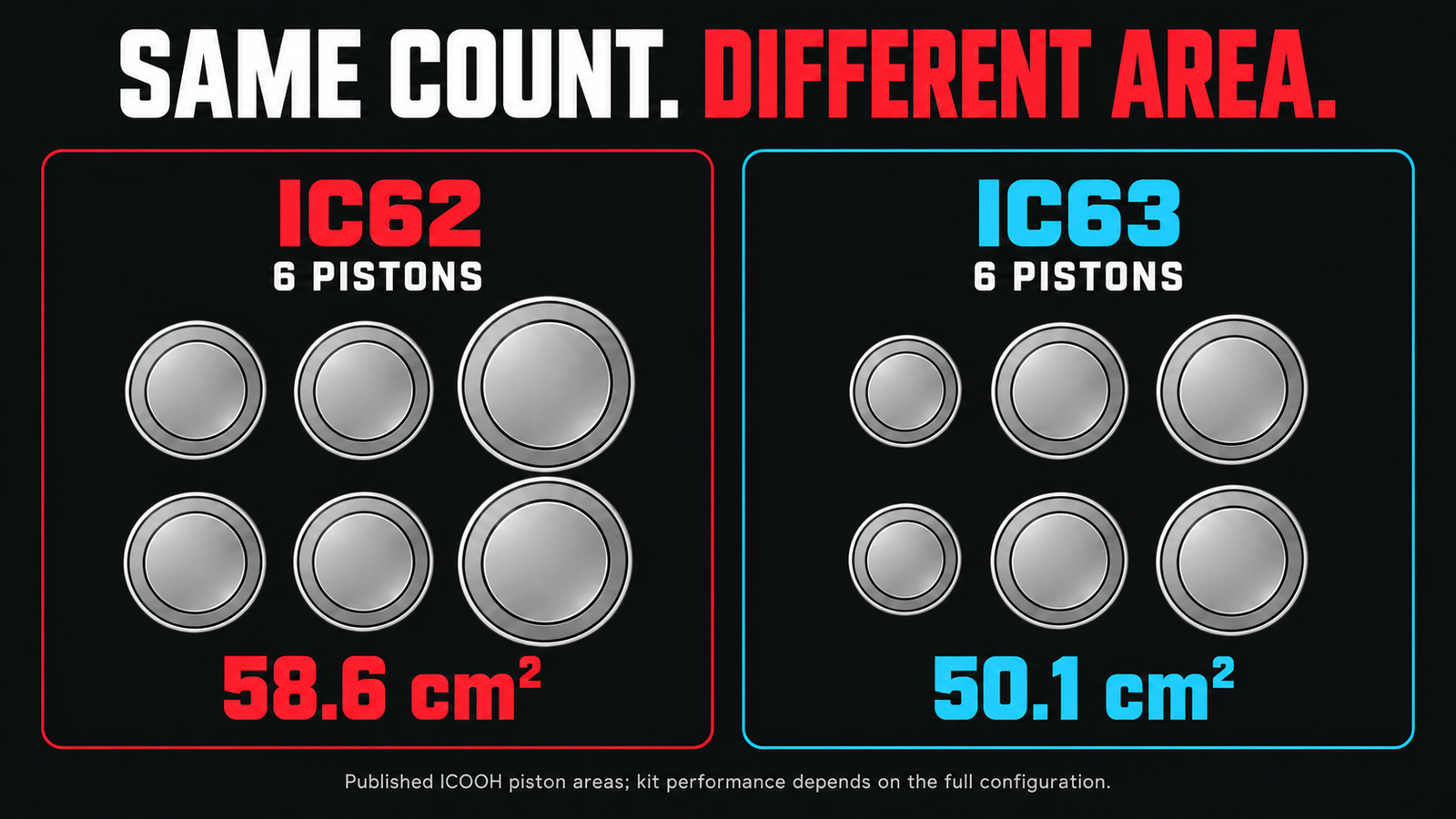
| IC62 | 31.8 mm × 4; 41.3 mm × 2 | 58.6 cm² |
| IC63 | 27 mm × 2; 31.8 mm × 2; 38.1 mm × 2 | 50.1 cm² |
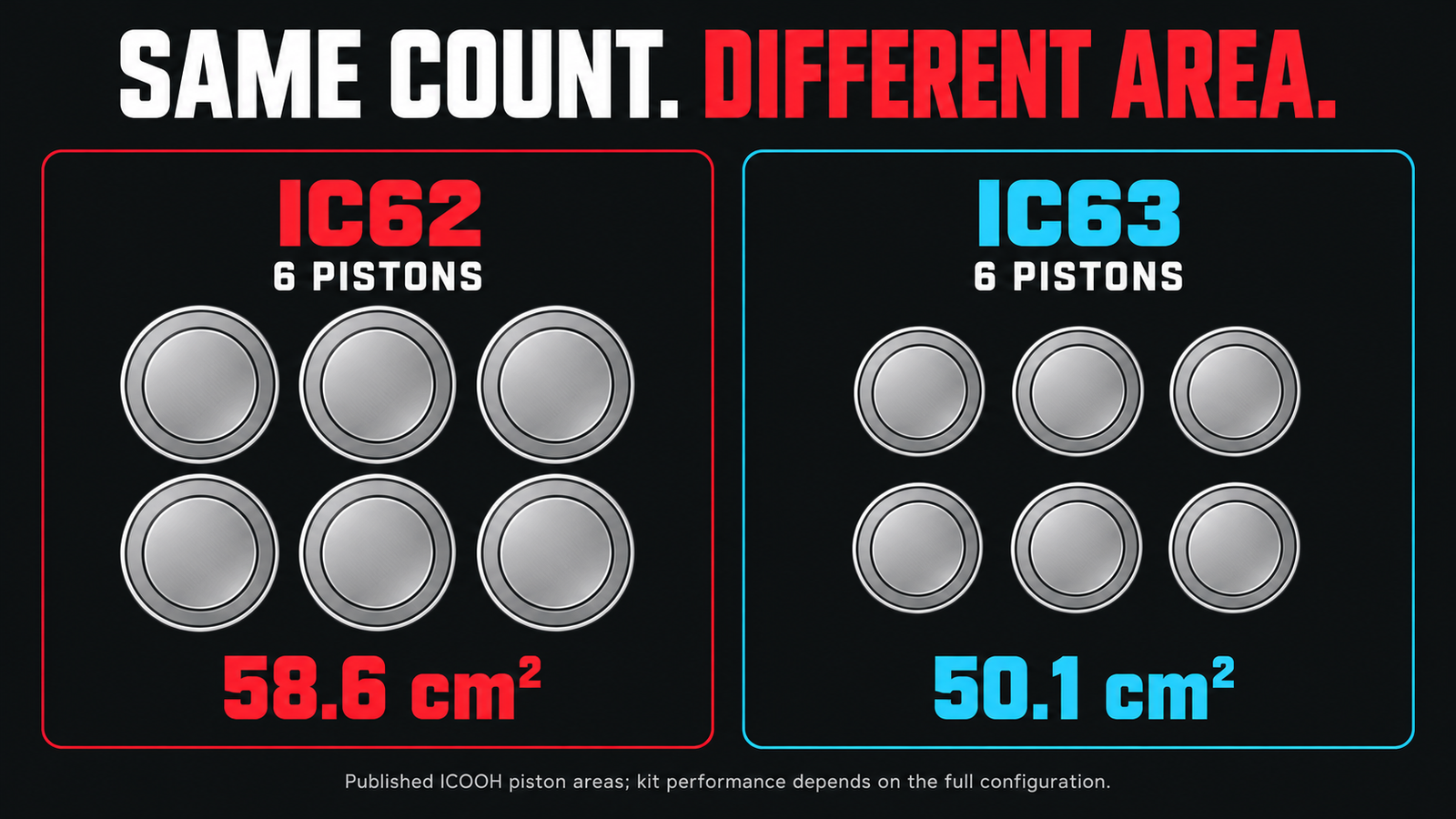
IC62 and IC63 have the same piston count and different published areas. The IC61 diameters show a third arrangement. When you inquire, name the variant: “IC6” alone does not specify the caliper you are evaluating.
The IC62 and IC63 figures match a calculation adding the areas of all six listed pistons. Other manufacturers may publish a different area convention. Wilwood’s technical guide, Per esempio, defines an opposed caliper’s effective piston area as the sum on one side. Check the definition before comparing ICOOH and another brand’s area figures or using them in a hydraulic calculation.
What changes when a caliper has more pistons?
Brake-line pressure acts on the pistons to press the pads against the rotor. The effective piston area helps determine the resulting force. Piston count alone leaves out the diameters that determine that area.
A different caliper design may also accommodate a different pad. That can affect service life, repeated-braking use and the space the caliper needs inside a wheel. For a concrete example, Essex describes two six-piston AP Racing calipers offered for some of the same applications. The CP9660 accepts an 18 mm-thick pad; the CP9668 accepts a 25 mm-thick pad. Essex says the CP9668 is roughly 14 mm wider, costs about 14 mm of wheel-spoke clearance, and requires buyers to check its own fitment template. Same piston count; different choice for the driver and installer. See the Essex product guidance.
When two kits have the same piston count, compare their pad, caliper width and wheel-clearance drawings. A count printed in a product title cannot settle those differences.
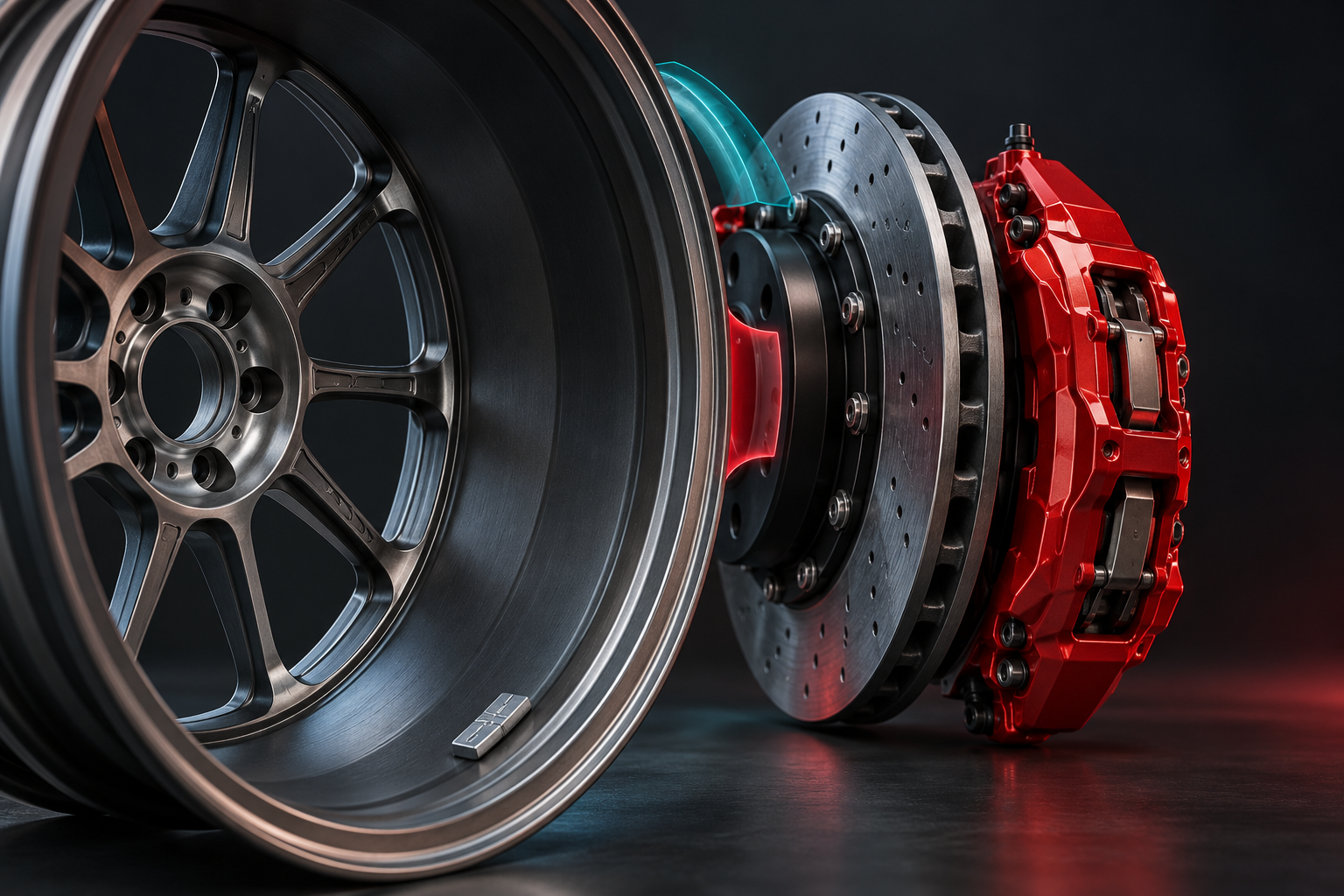
The rotor matters too. A larger diameter moves the point where the caliper acts farther from the wheel center, increasing leverage. Rotor construction and material affect how the system manages repeated heat. AP Racing explains these effects in its disc-choice guide. For an ICOOH comparison, record rotor diameter, thickness and material alongside the caliper variant.
Will more pistons shorten stopping distance?
Piston count alone doesn’t decide stopping distance. Tires set the available road grip, while the pad, rotore, brake condition and vehicle setup determine how the braking system uses it. If your current brakes already reach the tires’ grip limit in a single stop, a higher piston count offers no guaranteed shorter distance.
Repeated hard stops present a different question. If performance changes as the brakes heat up, compare pad suitability and rotor heat capacity along with the caliper. Describe when the change occurs—after one stop, several downhill stops, or laps on track—before deciding which kit is worth buying.
Compare DM4, IC6 and IC10 by axle and configuration
Our DM4, IC6 and IC10 series are examples of 4-, 6- and 10-piston layouts. Check the axle before comparing them: DM4 is listed for the rear, Mentre IC6 E IC10 are front kits. DM4 is therefore not a front-axle alternative to either IC6 or IC10.
| Serie | Published role | Rotor information | Wheel-size screening |
|---|---|---|---|
| DM4 | Four-piston rear kit with DM41, DM42 and DM43 variants | Product page lists 355–380 mm disc choices | 18–19 inches |
| IC6 | Six-piston front kit with IC61, IC62 and IC63 variants | General series page lists 380, 390 E 410 mm choices; vehicle-specific kits may differ | 19 pollici e superiori |
| IC10 | Ten-piston front kit | Standard steel-disc specification: 400–440 mm diameter × 32 mm thickness; confirm carbon-ceramic dimensions separately | 20–22 inches |
Our IC10 specifications include three piston-size groups with listed areas of 61, 55 E 42 cm². These are configurations to match to a vehicle, not three guaranteed braking results. DM4 and IC6 also offer different piston arrangements within their respective series.
DM4 and IC6 product pages list carbon-alloy and carbon-ceramic rotor options; IC10 can also be upgraded to carbon-ceramic discs. When requesting a carbon-ceramic setup, ask for its own disc dimensions and compatible pad. Do not carry the standard steel-disc thickness into that option.
We do not offer IC10 for wheels smaller than 20 pollici. A wheel of 20 inches or more still needs its inner shape checked against the selected caliper and rotor.
How to choose a candidate kit
1. Identify the vehicle and axle
Write down the make, modello, anno, trim and current brake setup. Decide whether you want to upgrade the front axle, rear axle or both. Search our brake-kit applications for a starting point, then confirm the exact vehicle version through an inquiry.
If you are considering both axles, tell us the proposed combination. Rear upgrades also require a check of the vehicle’s parking-brake arrangement. Nostro Philippines Toyota Prado project, Per esempio, documents a DM6 six-piston product together with a DM4 four-piston product. The front product in that project was DM6, not IC6.
2. Diagnose the reason for the upgrade
Use the problem you actually experience to decide which specifications deserve attention first.
| Your situation | Check first | What it tells you |
|---|---|---|
| You want a shorter single stop | Tire condition and grip, then the condition of the existing brakes | Paying for more pistons alone is unlikely to answer the question. |
| Braking response changes after repeated hard stops | Current pads, rotor specification and how often the brakes heat up | Compare the candidate kits as complete heat-management setups. |
| The pedal has become unusually soft or long | Existing brake condition, fluid and installation | Have the current system checked before treating an upgrade as the repair. |
| You want a front upgrade and have limited wheel space | Rotor size and the exact caliper drawing | Start with the series intended for your wheel diameter, then check barrel and spokes. |
| You want front and rear upgrades together | Vehicle-specific brake balance and parking-brake requirements | Have the combination reviewed as a system. |
A larger caliper earns its cost when the complete kit addresses the limitation you have identified. This is also why a pad or rotor discussion may be more useful than moving directly to the highest piston count.
3. Screen the published series by wheel diameter
Your advertised wheel diameter is an initial filter. It does not describe the clearance behind the spokes or inside the barrel.
| Wheels you own | Front-axle series to investigate | Rear-axle series to investigate |
|---|---|---|
| 17 pollici | DM5, DM6 O IC5 | DT48, subject to its electronic parking-brake application |
| 18 pollici | DM5, DM6 or IC5 | DM4 O C4 |
| 19 pollici | IC6 O IC7 | DM4 or IC4, where the vehicle application matches |
| 20–22 inches | IC6, IC7 or IC10, according to the vehicle and selected rotor | Check the matching rear kit for the vehicle |
For IC4, our main product page says 18 pollici e superiori, while a store listing uses a different 17–19-inch title. Request the exact IC4 product reference before applying either range to your wheels.
Prossimo, follow the checks in our wheel-clearance guide. The chosen caliper and rotor must clear the wheel’s inner barrel, spoke backs and wheel weights. Ask us for the drawing and minimum gaps belonging to that configuration.
4. Compare complete quotes, including future costs
Once you have two vehicle-appropriate candidates for the same axle, compare the caliper variant and piston sizes; diametro del rotore, thickness and material; pad specification; verified wheel-clearance requirements; and the quoted kit price plus replacement pad and rotor costs.
Per esempio, “I am considering an IC61 with a 380 mm front disc—is that combination suitable for my vehicle and wheels?” gives us a configuration to assess. “I want six pistons” does not identify the parts to check.
A more expensive kit may be worthwhile for the demands you described. Compare its complete specification and ongoing consumables against a suitable lower-cost candidate. Prices change with the vehicle and disc choice, so check the current product listings or request a configuration-specific quote instead of relying on a fixed figure in an article.
Confirm fitment and availability before you order
Send these five items through our modulo di richiesta di montaggio:
- Veicolo: Fare, modello, anno, trim and VIN if available; note existing brake, hub or suspension modifications.
- Axle and use: front, rear or both; describe daily driving, carichi pesanti, repeated hard stops or track sessions.
- Candidate kit: series, caliper variant, and proposed rotor diameter, thickness and material.
- Ruote: marca, modello, diametro, width and offset; separate the front and rear specifications if they differ.
- Clearance information: photos of the inner barrel, rispose, mounting face and wheel-weight locations, plus measurements you already have.
We can review the vehicle application and proposed brake-system combination, then tell you which drawing and minimum clearances apply. If the wheel needs more measurements, we will identify them. Essex’s vehicle-specific kit explanation provides an example of why this review matters: it says its piston sizes were chosen to work with the original master cylinder, ABS and rear brakes for that application. Your ICOOH configuration needs its own review.
Check availability at the same time. The generic IC6 entry in the ICOOH Store’s kit list displayed “Sold out” when this article was prepared, while vehicle-specific listings are separate. Ask us for the current ordering route and availability of the configuration we recommend.
Domande frequenti
Are ten pistons better than six?
Non automaticamente. Compare front kits that suit your vehicle, use and wheels. IC10 is an option only for wheels of at least 20 pollici, and its available piston-size and rotor configurations still need to be selected.
Can two six-piston calipers have different braking characteristics?
SÌ. Our IC6 variants list different piston sizes and areas. Calipers with the same count can also use different pads and occupy different amounts of wheel space. Specify the variant and the complete kit.
Can I use a six-piston front kit with 17-inch wheels?
Our published DM5, DM6 and IC5 pages identify 17-inch front-wheel applications. Select the vehicle-specific rotor and check your actual wheel’s barrel and spoke clearance before ordering.
Is a higher piston count worth the additional cost?
It is worth considering when the complete kit addresses a need your current setup does not meet, such as repeated-braking demands. Compare the full quote, wheel fit, and future pad and rotor costs. Piston count on its own is a poor basis for paying more.
Does a listed wheel diameter guarantee fit?
NO. A diameter gets you to a shortlist. The drawing for your chosen caliper and rotor, checked against the actual wheel, provides the clearance information needed for a purchase decision. Invia i dettagli del tuo veicolo e della ruota tramite il nostro modulo di richiesta di montaggio.