
<!문서 유형 HTML>
Brake systems 101
A big brake kit (BBK) is a matched aftermarket brake-system upgrade, usually built around a larger rotor and a higher-capacity caliper, that replaces the equivalent factory components on one axle or all four wheels. This article covers what’s typically included in a kit, how those parts work together, and how a BBK differs from a factory system at a basic level.
What “빅 브레이크 키트” Actually Means
“큰” primarily describes a larger rotor diameter and, 대개, a higher-capacity caliper compared to the factory equivalent. In common automotive usage, the term refers to increased rotor size or overall brake-system capacity — there’s no industry-wide size cutoff that separates a “큰 브레이크 키트” from a standard replacement part.
A more useful way to think about it: BBK는 더 큰 로터를 중심으로 한 일치하는 시스템 업그레이드입니다., 다른 캘리퍼스 디자인, 또는 더 큰 전체 토크 및 열용량, 모든 제조업체가 동일한 사양으로 구축하는 하나의 고정 구성이 아닌.
키트 범위는 애플리케이션에 따라 다릅니다.. 많은 키트가 앞 차축만 커버합니다.. 대부분의 승용차에는, 급감속 시 앞차축이 더 큰 제동력을 전달합니다., 제동을 하면 무게가 앞쪽 타이어로 이동하기 때문입니다. 이는 자동차의 정적 무게 분포에 따른 것입니다., 무게중심 높이, 그리고 휠베이스, 차가 앞에 있는지 여부는 중요하지 않습니다., 뒤쪽-, 아니면 전륜구동.[1]
일반적인 범위: 프론트 액슬 공유는 일반적으로 주변에서 실행됩니다. 60% 최대 75% 급제동 시 그 이상, 전륜 구동 자동차의 경우 처음에는 앞 차축에 너무 많은 무게가 가해지기 때문에 때로는 더 높이 착륙하기도 합니다.. 특정 자동차의 정확한 숫자는 무게 분포에 따라 다릅니다., 무게중심 높이, 휠베이스, 감속이 얼마나 어려운지 - 고정된 상수가 아닙니다..[1]
차축 및 후방 전용 키트도 존재합니다..
일반적으로 대형 브레이크 키트 내부에는 무엇이 들어 있습니까?
축차
공장 로터보다 직경이 더 큼, 이는 유효 로터 반경(패드가 실제로 로터의 마찰 표면과 접촉하는 반경)을 증가시킵니다.. 더 큰 유효 반경은 더 큰 로터가 제동 토크를 증가시키는 주된 이유 중 하나입니다..[2] 일부 로터는 공기 흐름을 위해 환기됩니다., 일부는 별도의 마찰 링과 중앙 허브가 있는 투피스 디자인을 사용합니다.. Cross-drilling and slotting show up on some rotors too — independent engineering tests on drilled and slotted rotors have found mixed results depending on rotor design and test conditions, with some showing improved heat rejection under sustained fade testing and others showing reduced friction surface area and higher crack risk with no measurable stopping-distance benefit on a single stop.[3] [4] 요컨대: they’re a rotor-surface design choice, not a requirement for a rotor to count as part of a BBK, and results vary enough by product that they shouldn’t be assumed to shorten stopping distance by themselves.
캘리퍼스
Usually a multi-piston design, commonly four or six pistons, and often a fixed body rather than the single-piston sliding design common on many factory cars. “Higher-capacity” 하나의 특정 사양이 아닙니다. 키트에 따라 다릅니다., 이는 더 단단한 캘리퍼 본체를 의미할 수 있습니다., 더 큰 총 피스톤 면적, 더 큰 패드를 위한 공간, 또는 지속적인 열에 대한 더 나은 내성.
명확히 할 가치가 있는: 유압 브레이크 시스템의 조임력은 브레이크 라인 압력과 캘리퍼의 전체 피스톤 면적의 곱입니다., 캘리퍼의 피스톤 수가 아닙니다..[5] 클램핑력은 유압에 따라 달라집니다., 총 피스톤 면적, 캘리퍼 강성, 및 패드 설계가 함께 작동 - 피스톤 수 자체가 아님.
패드
많은 완전한 키트에 포함됨, 작동 조건에 맞게 공식화되어 업그레이드된 시스템이 구축됩니다.. 이는 때때로 공장 패드보다 더 넓은 온도 범위를 의미합니다., 항상 그런 것은 아닙니다. 일부 BBK 패드는 더 넓은 범위에 맞게 설계되지 않고 특정 로터 및 캘리퍼 조합에 단순히 일치합니다..
윤곽
일부 키트는 고무 라인 대신 스테인리스 스틸 브레이드 라인으로 교체됩니다., 압력에 따른 팽창에 저항하는 것. 이것이 눈에 띄게 더 단단한 페달 느낌으로 해석되는지 여부는 교체되는 공장 라인의 상태와 유압 시스템에 다른 문제가 있는지 여부에 따라 달라집니다., 갇힌 공기처럼, 라인 스왑만으로는 문제가 해결되지 않습니다..
장착 하드웨어
업그레이드된 로터와 공장 허브에 대해 더 큰 캘리퍼를 올바르게 배치하는 키트별 브래킷.
| 요소 | 기본 역할 |
|---|---|
| 축차 | 패드가 고정되는 마찰 표면; 토크 레버리지 및 열용량에 기여 |
| 캘리퍼스 | 피스톤을 수용하고 패드에 조임력을 가합니다. |
| 패드 | Create friction against the rotor to generate braking torque |
| 윤곽 | Transfer hydraulic pressure from the master cylinder to the caliper |
| Mounting hardware | Positions and secures the rotor and caliper to the hub |
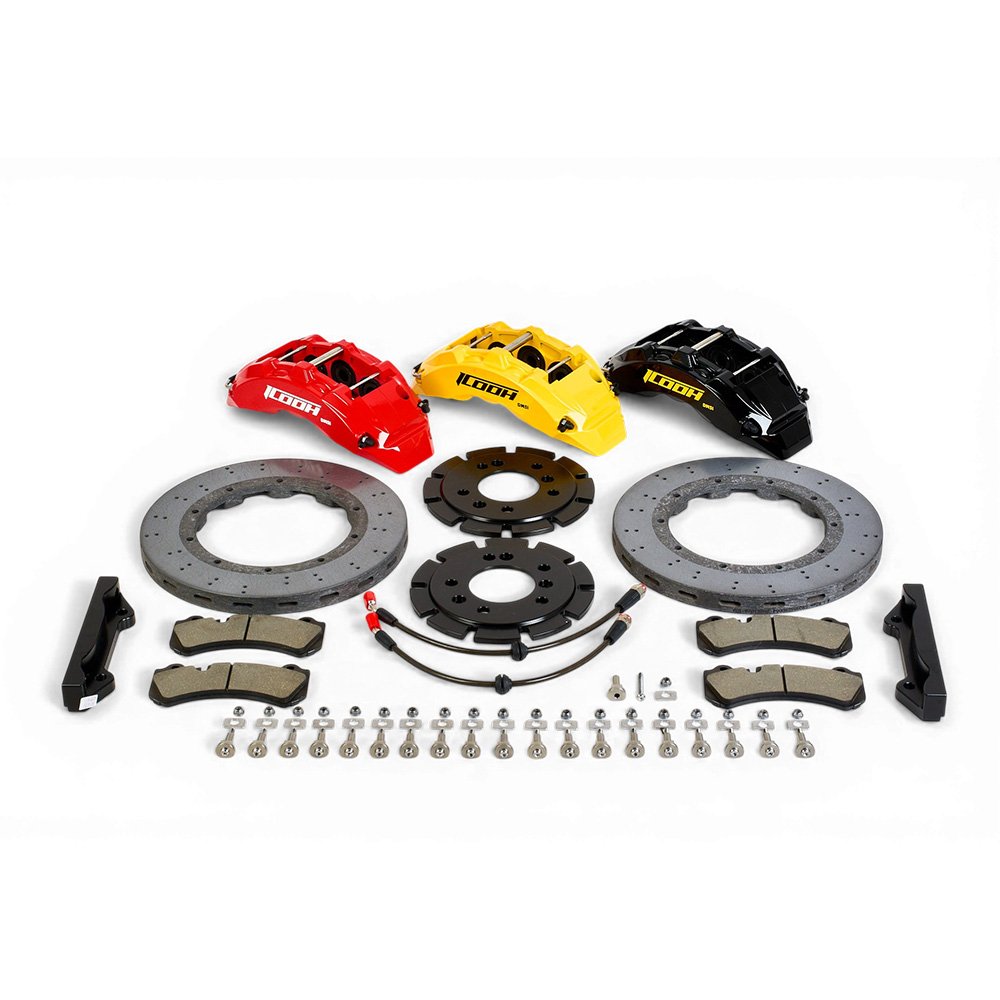
Kit contents vary by manufacturer and configuration. Some include everything above; others cover just the rotor and caliper. There’s no single fixed parts list that defines a big brake kit — and none of these parts work in isolation. 로터, 캘리퍼스, 패드, and hydraulic lines function as one connected system, so upgrading one piece only pays off if the rest are matched to it.
How a Big Brake Kit Works, in Plain Terms
Braking starts with a simple chain. Pressing the pedal moves a piston inside the master cylinder, which pressurizes the brake fluid. That pressure travels through the lines to the caliper pistons. The pistons clamp the pads against the spinning rotor. Friction between pad and rotor creates braking torque at the wheel. The tire then converts that torque into an actual slowing force against the road.[6]
PEDAL -> MASTER CYLINDER -> HYDRAULIC PRESSURE -> CALIPER PISTONS
      -> PAD-TO-ROTOR FRICTION -> WHEEL BRAKING TORQUE -> TIRE-ROAD FORCE

      [ A big brake kit changes THIS section of the chain ]
                     caliper - pads - rotor
A BBK changes the middle of that chain: the caliper, 패드, 그리고 로터. It doesn’t touch the driver’s pedal input or the tire. A larger effective rotor radius increases how much torque a given clamping force can produce, since torque scales with the distance from the rotor’s center to where the pad grips it[2] — a leverage effect on torque, not a change to how much grip the tire has.
That distinction matters because braking torque and vehicle deceleration aren’t the same thing. Torque is what the brake system generates at the wheel; how much of that torque actually translates into slowing the car down still depends on tire grip, vehicle weight and load, and how the car’s ABS or stability-control system manages front-to-rear balance.
A bigger brake kit leaves several of those variables untouched: it doesn’t give the tire more grip, it doesn’t fix an existing hydraulic fault, and installing one doesn’t automatically retune the factory ABS or stability-control calibration — though changing piston area, 로터 크기, or front-to-rear brake balance can change how that system behaves in practice, which is one reason kit installers check compatibility rather than assuming nothing changes. If the tire is already at its grip limit under the factory brakes, extra torque capacity has nothing more to grip during that one stop, so a bigger kit doesn’t guarantee every stop gets shorter.
Where a BBK’s advantage tends to show up more reliably is across a string of hard stops, not a single one. A vehicle’s kinetic energy has to go somewhere when it brakes, and that energy converts mostly into heat at the rotor and pad. A smaller-capacity system can start losing effectiveness as that heat builds up over repeated hard stops; a system with greater heat capacity and better heat management is built to hold its performance longer under that same repeated load.[3] Even then, how much of an edge a specific BBK holds comes down to its pad compound, 유동적 상태, and how well the whole system is matched — not rotor size on its own.
Heat capacity itself depends on more than diameter. A larger rotor can generally store more heat before it loses effectiveness, but that has more to do with the rotor’s mass, 두께, and material than its diameter alone. How fast that heat then leaves the rotor is a separate question, driven by ventilation and airflow design. The caliper isn’t the primary heat-storage component in the system — its main job is clamping force and staying rigid under load — though it does absorb some heat in use, which is part of why fluid condition inside the caliper also matters to consistent pedal feel.
Big Brake Kit vs. Stock Brakes: Basic Differences
| Stock (OEM) Brakes | 빅 브레이크 키트 | |
|---|---|---|
| 로터 크기 | Sized for the vehicle’s standard duty cycle | Larger diameter, increasing effective torque leverage |
| Caliper design | Often single-piston, sliding body | Often multi-piston, fixed body |
| Pads and lines | Matched to factory specifications | Sometimes upgraded as part of the kit |
| Typical design focus | Balanced for cost, weight, and everyday use | Increased torque and heat capacity for higher-load conditions |
This is a basic snapshot of what changes structurally. A more detailed comparison, including why OEM systems are engineered the way they are, is covered in a separate, more technical article.
Common Questions About Big Brake Kits
- What does BBK stand for?
- BBK stands for Big Brake Kit.
- Does a bigger brake kit always mean better brakes?
- 자동이 아님. A BBK can raise torque capacity and heat tolerance, but the payoff depends on how well the rotor, 캘리퍼스, 패드, and hydraulics are matched to each other and to the vehicle. “Bigger” describes a category of upgrade, 보장된 성능 수준은 아니며, 타이어가 이미 그립 한계에 도달한 경우 추가 토크 용량은 도움이 되지 않습니다..
- 모든 대형 브레이크 키트에 패드와 라인이 포함되어 있습니까??
- 아니요. 일부 키트에는 패드와 라인이 포함되어 있습니다.; 다른 것들은 로터와 캘리퍼만 덮습니다., 제조사에 따라 내용이 다름.
- 대형 브레이크 키트는 앞바퀴에만 설치되나요??
- 많은 키트가 전면 전용입니다., 일반적으로 앞 브레이크는 급감속 시 전체 제동력에서 더 큰 부분을 차지하기 때문에(보통 60~75% 범위), 정확한 분할은 차량의 중량 분포에 따라 다르지만, 무게중심 높이, 그리고 휠베이스.[1] 후면 및 전체 4륜 키트도 존재합니다..
- 하다 “큰 브레이크 키트” 모든 브랜드에서 동일한 의미?
- 정확하지 않음. 일반 카테고리 용어입니다, 그래서 로터 크기, 캘리퍼스 디자인, and included parts vary by manufacturer and price tier.
- Is a big brake kit the same as just changing brake pads?
- 아니요. A pad swap changes one component. A BBK typically changes the rotor and caliper too — a bigger structural shift in how the system generates and manages braking torque.
출처 & 기술 참고자료
- Swonger, B. Optimizing Brake Bias in Formula SAE: A Framework for New and Existing Members. McKelvey School of Engineering, Washington University in St. Louis, Mechanical Engineering and Materials Science Independent Study, 2024. (openscholarship.wustl.edu/mems500/281)
- Effective rotor radius and its relationship to braking torque — brake system engineering reference, r/FSAE technical discussion citing standard brake-torque formula (line pressure × piston area × pad friction coefficient × effective rotor radius = brake torque). (reddit.com/r/FSAE)
- Corvette Forum, engineer-conducted track fade test comparing drilled and slotted rotors, simulated 124 mph fade cycle. (corvetteforum.com)
- Jeep Forum discussion citing reduced friction surface area and cracking risk on cross-drilled rotors in street use. (jeepforum.com)
- Brake & Front End (trade publication for the automotive repair industry), “Car Brake: PSI & Clamping Forces.” (brakeandfrontend.com)
- FFCars technical forum discussion on caliper clamping force as the product of brake line pressure and total piston area. (ffcars.com)
Related Reading
- 대형 브레이크 키트란?? BBK 대 OEM 브레이크 설명
- Do You Need a Big Brake Kit?
- Big Brake Kit Wheel Fitment Guide