
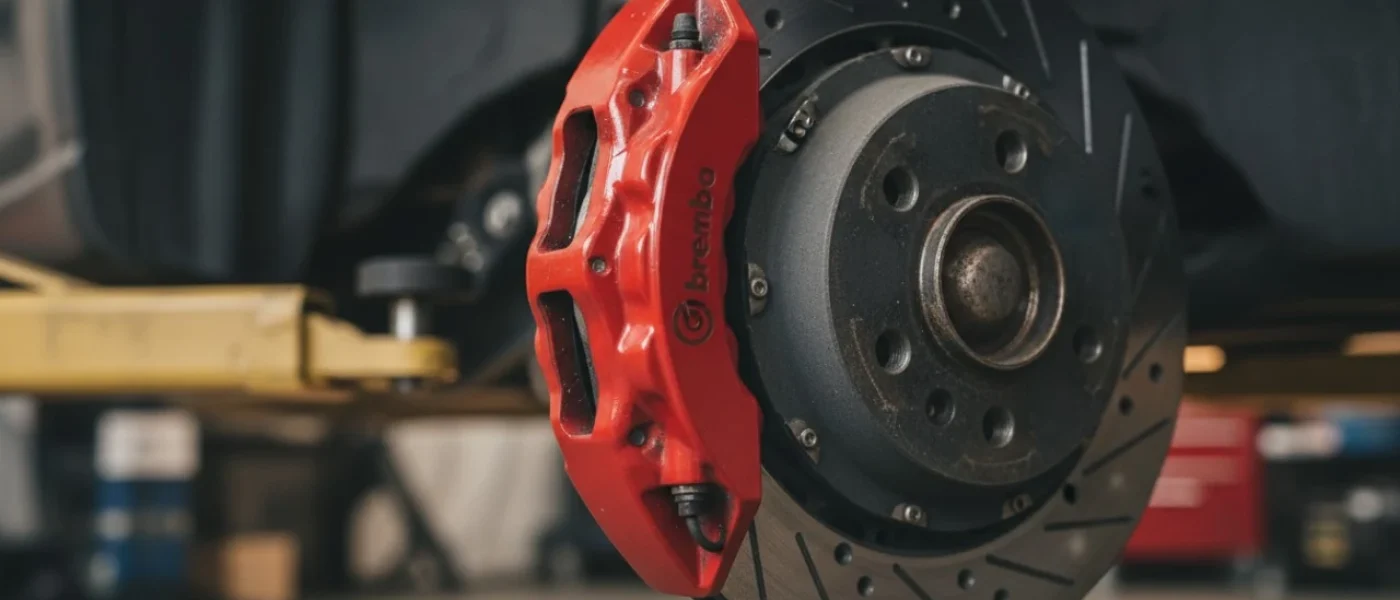
Caliper brake pads are the sacrificial friction components within a disc brake system that clamp onto the rotor to convert kinetic energy into thermal energy.
When you press the brake pedal, hydraulic fluid forces the pistons inside the disc brake caliper assembly to push the pads against the spinning rotor. This action creates the friction necessary to slow or stop the vehicle.
The Mechanics of Friction
While the concept is simple, the engineering behind modern braking is complex. The effectiveness of a brake pad is defined by its ability to maintain a consistent friction coefficient mu rating under varying temperatures.
- Kinetic Conversion: The system turns motion into heat (up to 1,200°F in performance applications).
- Hydraulic Actuation: The caliper acts as a clamp, magnifying the force from your foot.
- Component Synergy: For optimal performance, the pads must match the rotor material and caliper stiffness.
Industry Insight: At Guangzhou Wantian Industrial Co., Ltd. (ICOOH), we design big brake kits that integrate high-performance calipers with matched friction materials. With coverage for over 99% of vehicle models, our engineering focuses on minimizing pad taper and ensuring even pressure distribution across the pad surface.
2026 Regulations: The Rise of Copper-Free Friction Materials
As of 2025/2026, stringent environmental laws in California and Washington mandate that all brake pads sold must contain less than 0.5% copper by weight.
Why Copper is Being Phased Out
Copper was traditionally used in brake pads to dissipate heat and improve friction. Однако, brake dust containing copper washes onto roads and eventually flows into waterways, where it is highly toxic to salmon and other aquatic life.
Identifying Compliant Pads
To ensure you are buying legal, eco-friendly pads in 2026, look for the “Leaf Mark” on the packaging.
- Level A: < 0.1% Asbestos, Cadmium, Chromium, Lead, Mercury.
- Level B: < 5% Copper (Phased out by 2025).
- Level N: < 0.5% Copper (The new copper-free friction materials standard for 2026).
Material Science: Ceramic vs. Semi-Metallic vs. NAO
Selecting the right brake pad material depends entirely on your driving environment, vehicle weight, and thermal requirements.
1. Ceramic Brake Pads (The Daily Driver Standard)
Composed of dense ceramic clay and copper fibers (now replaced by other alloys in “N” level pads), these are the gold standard for street comfort.
- Pros: Extremely quiet, low dust, and stable performance across a wide temperature range.
- Cons: Higher cost and less “initial bite” in freezing temperatures.
- Best For: Commuters, luxury sedans, and drivers who hate cleaning brake dust.
2. Semi-Metallic Brake Pads (The Workhorse)
These contain 30% к 70% metal (steel, iron, wire) combined with graphite lubricants. They offer the highest friction coefficient mu ratings.
- Pros: superior heat dissipation, excellent stopping power, and fade resistance.
- Cons: Noisier, abrasive on rotors, and produce significant black dust.
- Best For: Towing trucks, трек-дни, and heavy SUVs.
3. Non-Asbestos Organic (NAO)
Made from fiber, glass, rubber, and Kevlar bound by resin.
- Pros: Softest pedal feel and quietest operation.
- Cons: Fast wear rate and poor high-heat performance.
- Best For: Lightweight compact cars and relaxed driving styles.
EV Impact: Regenerative Braking Pad Wear
Electric vehicles (EVs) can extend brake pad life to over 100,000 миль, but they introduce new risks like caliper seizure and rotor corrosion.
The Paradox of “Clean” Braking
Regenerative braking pad wear is significantly lower than in Internal Combustion Engine (ICE) vehicles because the electric motor acts as a generator, slowing the car down magnetically to recharge the battery. The friction brakes are often only engaged for the final 5-10 mph of a stop.
The “Use It or Lose It” Problem
Because the mechanical brakes are underutilized, they face unique challenges:
- Corrosion: Rotors can rust from disuse, leading to a scraping sound when brakes are finally applied.
- Glazing: Pads can harden (glaze) if they never reach operating temperature.
- Seized Guide Pins: The caliper slide pins may freeze in place if not cycled regularly.
Maintenance Tip: If you drive an EV, perform a “friction cleaning” once a week. Shift into Neutral (safely) on a clear road and brake moderately from 40mph to 10mph. This forces the hydraulic brakes to engage without regenerative assistance, scrubbing the rotors clean.
Technical Guide: Brake Pad Bedding-In Procedure
Bedding-in is the critical process of thermally conditioning new pads and transferring a uniform layer of friction material onto the rotor face.
If you skip this step, you risk localized overheating, judder (vibration), and permanent squealing. This process is essentially “mating” the pad to the disc.
Step-by-Step Procedure
- Warm-Up: Drive gently for 5 minutes to bring components to a baseline temperature.
- The Cycles: Perform 5 к 8 aggressive decelerations from 60 mph to 10 mph.
- Do not come to a complete stop.
- Accelerate immediately back up to speed.
- Cool Down: Drive for 10-15 minutes at highway speeds with minimal braking to allow the system to cool naturally.
- Park: Park the vehicle and let the brakes cool completely (at least an hour) before driving again.
Why this matters: This brake pad bedding-in procedure ensures that the resin in the pads cures correctly, preventing “green fade” (gas release) during your first emergency stop.
Understanding Friction Coefficient Mu Ratings
The “Mu” (μ) rating is a two-letter code stamped on the back of every brake pad that indicates its grip level at different temperatures.
When upgrading your brakes or installing an ICOOH big brake kit, understanding these codes ensures you get the performance you expect.
- First Letter: Friction coefficient at 250°F (Low Temp).
- Second Letter: Friction coefficient at 600°F (High Temp).
Common Mu Ratings:
- EE (0.25 – 0.35): Standard economy pads. Fade quickly.
- FF (0.35 – 0.45): Most OEM pads. Good balance for street use.
- GG (0.45 – 0.55): High-performance street/track pads. Excellent bite.
- HH (0.55 – 0.65): Dedicated racing pads. Aggressive bite but may eat rotors.
Troubleshooting: Sounds and Symptoms
Your brakes will often audibly tell you what is wrong before a catastrophic failure occurs.
- High-Pitched Squeal: Usually the wear indicator tab scraping the rotor. Replace pads immediately.
- Grinding: Metal-on-metal contact. The friction material is gone, and you are destroying your rotors.
- Clicking: Loose anti-rattle clips or improper fitment in the caliper bracket.
- Pulling to One Side: A seized caliper piston or slide pin on one side of the vehicle.
The Importance of Hardware
When changing pads, always replace the abutment clips and springs. At Guangzhou Wantian Industrial Co., Ltd., our R&D team utilizes 3D modeling to ensure that every clip in our kits provides the precise tension needed to prevent pad rattle without inducing drag.