
Bremssysteme 101 — Rotor Surfaces
The word coated tells you little about a brake rotor until you know where the treatment sits. A finish on the hat and cooling vanes protects visible cast iron from corrosion. A treatment on the swept friction ring may also change wear and pad requirements. Ferritic nitrocarburizing (FNC) modifies the iron surface itself. A carbon-ceramic rotor is a different base material.
For an owner dealing with orange rust, brake judder, or a product advertised as “laser treated,” the useful questions are: Which surface is treated? What measurable problem does the treatment address? What happens as the rotor wears? The answers below refer to the named processes and products; test results for one design should stay with that design.
| Rotor technology | What changes | Where it matters most | Main question to ask |
|---|---|---|---|
| Conventional protective finish | A thin external barrier on cast iron | Hat, outer edge, cooling vanes; sometimes the swept face at delivery | Which areas remain protected after bedding? |
| FNC | Nitrogen and carbon diffuse into the cast-iron surface | Treated surfaces, including the friction ring | Which post-oxidation and geometry controls were used? |
| Hard friction-face coating | A deposited wear surface on cast iron, often applied by LMD or HVOF | The pad-to-rotor contact surface | Which pads and replacement criteria belong to the system? |
| Carbon-ceramic rotor | A different composite rotor body | The entire rotor | What material and matching pad system is specified? |
Why a new rotor can rust overnight
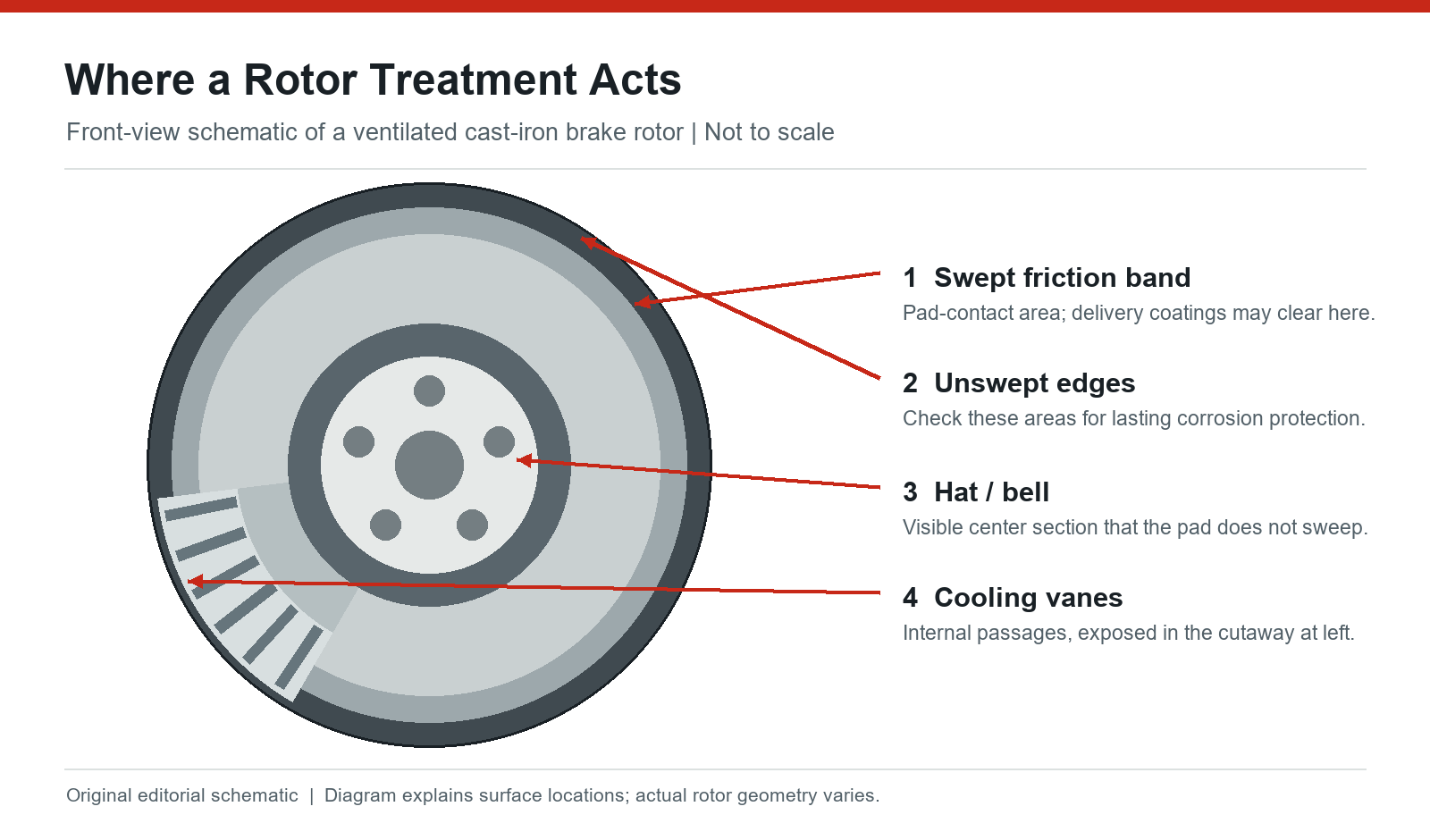
The swept face of an ordinary cast-iron rotor is exposed to air and moisture. Light orange film after rain or washing is common; the pads usually clear it during normal driving, as Delphi's storage guidance explains. On a new fully coated rotor, the protective finish can also clear from the swept face during the first braking events while remaining on unswept areas. A silver braking track is therefore normal for this type of finish. Raybestos corrosion bulletin
Location and duration matter more than the first orange color. Road salt, Schnee, and coastal air accelerate corrosion, especially where the pads never sweep: the outer and inner edges and the cooling vanes. Raybestos describes corrosion creeping under the friction material at an unswept edge. Das rust jacking can lift material, disturb contact, and contribute to uneven wear and disc thickness variation (DTV). The driver may then feel pedal pulsation. Corrosion of the vanes can also obstruct airflow through the rotor. A technician should measure lateral runout as well as DTV when investigating a persistent pulse; they are separate measurements, and one should not be inferred from the other. Raybestos technical bulletin
If a vehicle sits for weeks, check whether the film clears after normal use. Persistent roughness, a growing band of corrosion at the edge, or a continuing pulse deserves inspection. Delphi suggests driving a stored vehicle regularly and mentions a 20-minute weekly drive as one maintenance measure. Parking-brake use during storage needs to follow the vehicle manual and the parking conditions; there is no universal safe instruction to leave a parked vehicle unsecured. Delphi storage guidance
This is particularly relevant to vehicles that rely heavily on regenerative braking. Less frequent friction-brake use gives moisture more time to act on a cast-iron rotor. It helps explain why corrosion control has become a design topic for electric vehicles, alongside brake-particle emissions. SAE 2024 technical paper
Protective coatings: what survives the first stops?
Zinc-based finishes, zinc-aluminum flake systems, and polymer coatings are all sold under the broad label coated rotor. Their chemistry, coverage, and thickness differ. The most important distinction for everyday ownership is whether the coating reaches the hat, outer edge, and internal vanes, or only the visible hat.
Brembo says its Prime UV disc has a polymer-based UV coating applied to the braking band, outer diameter, and bell. The company describes continued protection after installation. Its list of coated areas does not specify the internal cooling vanes, so check the exact product drawing if vane coverage matters to you. Brembo Prime UV disc
GEOMET 360 illustrates a different protective finish. Its maker, NOF Metal Coatings, describes a zinc-aluminum flake coating applied by spraying and curing, with a configurable nominal thickness of 5–20 μm in one or two layers. The figure applies to GEOMET 360; coverage and local thickness depend on the component and application process. NOF GEOMET 360 product information
When comparing two protective rotors, ask for a photo or drawing of the unswept surfaces. A coating that stays on the vanes and edges addresses long-term corrosion more directly than a finish limited to the hat. It also helps distinguish a true fully coated rotor from a hat-only cosmetic finish.
FNC: a changed iron surface, with process details that matter
Ferritic nitrocarburizing is a thermochemical treatment. Nitrogen and carbon diffuse into the near-surface region of a gray cast-iron rotor. That makes it fundamentally different from a paint-like barrier deposited on top. Treatment can reach the friction surface, so a simple “the pads wipe it off” explanation does not apply.
Why use it? Rusting cast iron can lose material as corrosion products are rubbed away, creating wear, Vibration, and particle-emission concerns. The issue is prominent when friction brakes are used less often, as on some electric vehicles. FNC, sometimes combined with a post-oxidation step, is one route manufacturers study for corrosion control. SAE technical paper on FNC and post-oxidation
The letters FNC do not specify a fixed corrosion grade. In a supplier study, conventional FNC lasted under 20 hours in its salt-spray test without corrosion, while FNC combined with that supplier's Smart ONC post-oxidation reached bis zu 120 hours under the reported conditions. These figures compare the two studied FNC treatments. GEOMET 360's separately published salt-spray hours come from a different test program; compare specimens and failure criteria before ranking the two processes. FISITA EuroBrake paper; NOF GEOMET 360
Geometry also needs process control. A peer-reviewed 2024 study measured lateral runout (LRO) and DTV before and after FNC on two ventilated gray-iron rotor sizes. For its 326 × 23 mm Disc P, mean post-FNC LRO was 0.043 mm after natural aging and 0.023 mm after stress relief. For its 348 × 29 mm Disc Q, mean post-FNC DTV was 0.018 mm after natural aging and 0.009 mm after stress relief. Across the studied groups, mean LRO rose from 0.010–0.016 mm before FNC Zu 0.020–0.043 mm after FNC; prior stress relief limited the change. The paper cites production limits of 0.040 mm LRO Und less than 0.013 mm DTV. In the two examples above, the naturally aged group means exceeded the relevant limits; the stress-relieved group means fell below them. These are the study's manufacturing measurements, not fitted-vehicle judder thresholds.
For a rotor sold as FNC-treated, the meaningful questions are which post-treatment was used and what the maker specifies for final LRO and DTV. The treatment name alone cannot answer either question.
“Laser treated” can mean two different jobs
Laser metal deposition (LMD) adds material to the friction face. A laser melts feedstock onto a cast-iron substrate, creating a hard deposited surface. Laser texturing or roughening can instead be a Vorbereitung step before another coating is applied. Those processes solve different manufacturing problems and should not share one performance claim.
Brembo's Greenance Plus uses nickel-free, dual-layer LMD with dedicated pads. Brembo sells it as an aftermarket disc-and-pad kit. Its September 2026 announcement reports up to 80% less disc surface wear in a dynamometer comparison with equivalent uncoated cast-iron discs, and up to 90% lower brake particulate emissions in a WLTP-Brake dynamometer cycle. A Brembo regional product footnote defines surface wear as mass lost through abrasion. That page attributes a 90% particulate figure to VDA/AK vehicle tests on a “Greenance brake.” This article uses the September announcement's WLTP-Brake description for its Greenance Plus claim.
High-velocity oxy-fuel (HVOF) spraying is another way to make a hard friction-face coating. Porsche describes its Surface Coated Brake as a cast-iron rotor with a tungsten-carbide surface. In its process description, laser treatment prepares the disc surface before intermediate and HVOF-applied layers are added. Porsche also specifies matching pads. The laser step there is preparation, while the deposited layers form the operating surface. Porsche technical material
For either type of hard-coated disc, the service question is concrete: identify the specified pad, the coating-wear inspection method, and the replacement criterion. A replacement pad selected only because it fits the caliper may not be suitable for the coated friction face.
Cleaning and bedding: check what was actually coated
Installers face two different starting conditions. A new uncoated rotor may carry water-soluble rust preventative and fine machining debris. In technical bulletin 23-01, Raybestos advises washing new uncoated rotors with detergent and water, then rinsing. Brake cleaner removes greasy fingerprints but, according to the bulletin, does not clear the metal shavings as effectively. A wipe with a clean white cloth can reveal remaining gray dust. Fully coated Raybestos rotors have already been cleaned before coating; the bulletin says they need no routine pre-installation wash, although detergent and water or brake cleaner can remove fingerprints. A hat-only painted rotor is a different case. Follow the cleaning instruction for the exact part in hand. Raybestos rotor-cleaning bulletin
Initial stops on a conventionally coated rotor clear the coating from the swept track. Bedding then establishes the pad-to-disc contact condition specified by the pad and rotor makers. Avoid inventing a universal number of stops: a standard replacement disc with street pads, an FNC disc, and a hard-coated disc with dedicated pads may have different procedures. Use the paired pad and rotor instructions, and check the resulting contact pattern.
If pulsing appears after installation, inspect basic geometry before blaming the surface treatment: clean mounting faces, correct wheel and disc fastening, measured LRO, and DTV. That sequence is more useful than treating every vibration as a “warped rotor.” Raybestos corrosion bulletin
Carbon-ceramic is a rotor material
A carbon-ceramic disc has a fiber-reinforced ceramic composite body, typically using carbon fibers and silicon carbide. It is not cast iron with a ceramic-colored protective coating. Some carbon-ceramic constructions add a separate ceramic friction layer; others do not. That is a detail of the rotor design, not a universal definition of “carbon ceramic.” Brembo SGL Carbon Ceramic Brakes; SGL Carbon brake technology
This distinction matters when reading claims about rust or weight. A finish on cast iron protects part of an iron rotor. A hard coating changes its working surface. A carbon-ceramic rotor changes the underlying material and calls for its own pad and service guidance. The technologies can therefore address overlapping concerns without being interchangeable.

How to read wear and brake-dust claims
Ask what was measured before comparing percentages. Brembo's 80% wear figure concerns disc mass lost through abrasion; its 90% figure concerns brake particulate emissions in the named test cycle. Those are separate metrics with separate test methods. Brembo Group; Brembo Parts footnote
Published research also shows why the rotor and pad should be read as a pair. In einem Lund University pin-on-disc laboratory study of refurbished cast-iron rotor materials, an HVOF coating gave the lowest disc wear in the tested set but the highest mating-friction-material wear. A laser-clad option had disc wear closer to the gray-iron reference. This was a controlled material-pair test, while Brembo reported a different disc-and-pad system on a dynamometer. Niedrig Rotor wear alone is an incomplete measure of system wear.
| Claim on a product page | The useful follow-up |
|---|---|
| “Corrosion resistant” | Which surfaces were treated, and what salt or field exposure was measured? |
| “80% less wear” | Wear of the disc, Unterlage, oder beides? Mass loss, thickness loss, or another metric? |
| “90% lower particulate emissions” | Which particles, test cycle, vehicle or dynamometer, and reference rotor? |
| “Laser treated” | Was laser used to deposit a working layer or to prepare the surface? |
| “No special maintenance” | Which pads, bedding instructions, and coating-wear limits apply? |
Häufig gestellte Fragen
Does a coated rotor lose its protection when the braking face turns silver?
On a conventional corrosion-coated rotor, the pads clear the delivery coating from the swept face. The hat, edges, and vanes can retain protection where the coating was applied. FNC and hard friction-face coatings follow different wear mechanisms.
Does every coated rotor need special brake pads?
NEIN. Conventional corrosion finishes generally use the pads specified for that rotor and vehicle; hard friction-face systems such as Greenance Plus and Porsche's Surface Coated Brake specify matched pads.
Is FNC a coating?
FNC is a diffusion treatment of the iron surface. Its corrosion performance depends on the full process, including any post-oxidation.
Can a laser-coated rotor reduce brake dust?
Some complete disc-and-pad systems have measured reductions under named test cycles. Check the reference system, particle metric, and whether the test included pad wear.
Is a “ceramic-coated” cast-iron disc the same as a carbon-ceramic disc?
NEIN. The former still has a cast-iron rotor body; the latter uses a ceramic composite body.
The practical distinction
Start with the surface you need to protect. For rust on a hat, edge, or cooling vane, inspect coating coverage. For a treated friction face, read the pad, bedding, and wear instructions. For FNC, ask about post-oxidation and final rotor geometry. For a claimed dust or durability gain, read the metric and test cycle. That short set of checks tells you more than the word coated on the box.
For the difference between rotor construction and its surface treatment, see ICOOH's floating brake disc guide. For a separate look at material and system behavior under repeated stops, see its IC6 carbon-ceramic dynamometer test.