
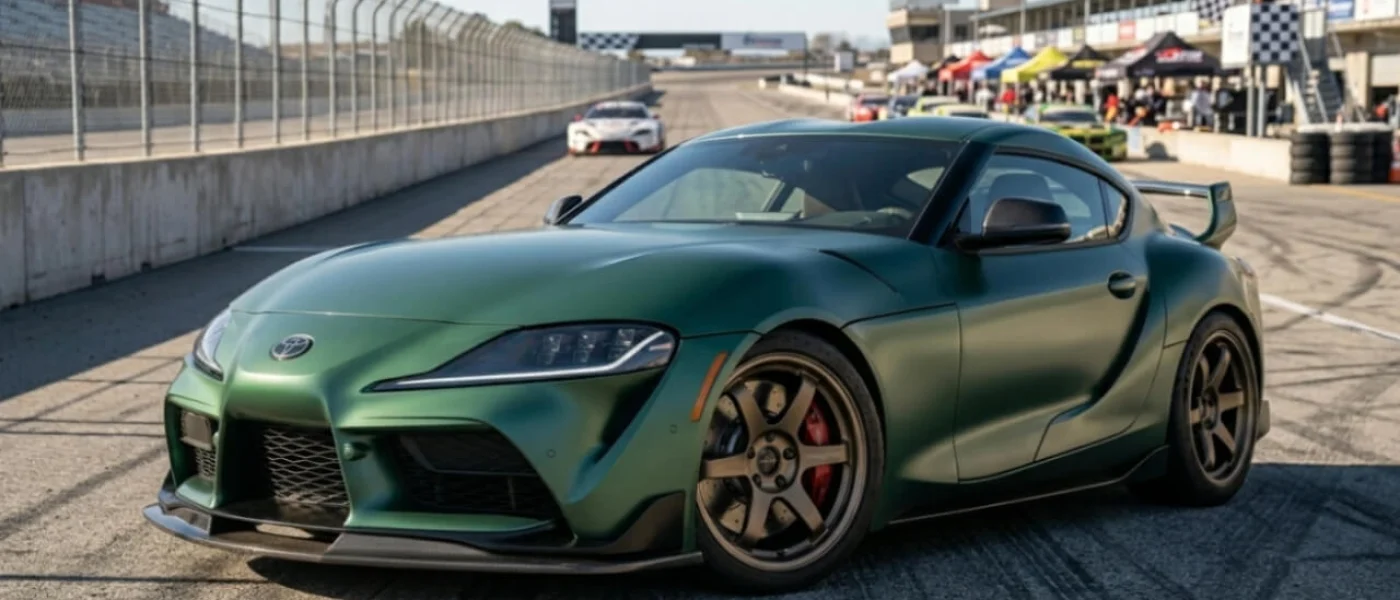
The key is not simply choosing the largest caliper or rotor available. A truly effective brake upgrade must work with the Supra’s weight transfer characteristics, ABS calibration, tire grip, and intended use. Even Toyota’s latest MkV Final Edition highlights this principle by introducing larger front brake calipers and rotors as part of its factory performance package, reinforcing how critical braking capacity is to the car’s overall dynamic balance.
1. Understand Where the Factory System Reaches Its Limit
The OEM Supra brake setup is well tuned for fast road use, but the moment the car is modified with stickier tires, ECU tuning, or suspension upgrades, the braking load increases significantly.
In real driving conditions, the first signs usually appear as:
softer pedal feel after repeated braking
longer stopping distances at high speed
reduced confidence entering corners
brake fade during aggressive use
Track-focused testing and aftermarket engineering data on the GR Supra consistently show that extended sessions generate far more heat than the stock system is designed to dissipate efficiently. Performance kits specifically address this by increasing disc size and caliper rigidity.
This is why experienced Supra owners often upgrade brakes before chasing additional horsepower.

2. Bigger Is Not Automatically Better
One of the most common mistakes is assuming the biggest brake kit is always the best solution.
In reality, braking performance depends on system balance.
An oversized front setup without proper piston sizing can disrupt front-to-rear brake bias, which affects stability under hard deceleration. Well-engineered Supra kits are designed specifically to maintain compatibility with the OEM master cylinder and ABS logic.
Leading GR Supra kits emphasize properly sized pistons and brake bias preservation rather than simply maximizing rotor diameter.
This is exactly why experienced builders focus on balanced braking torque, not just visual size.
3. Rotor Engineering Often Makes the Biggest Difference
Most buyers focus first on calipers, but rotor design is often where the most meaningful improvement happens.
A premium Toyota Supra aftermarket brake kit typically includes:
two-piece floating rotors
directional internal cooling vanes
slotted surfaces for gas evacuation
lightweight aluminum hats
These features dramatically improve thermal management.
For example, several GR Supra competition kits increase the front disc size from the factory 348mm to 372mm specifically to improve heat capacity and repeated stopping consistency.
This matters because brake fade is primarily a heat problem, not a size problem.
4. Pedal Feel Is What Drivers Notice First
From actual owner feedback and track-prepared setups, the most immediate difference after upgrading is rarely shorter stopping distance alone.
It is pedal confidence.
A stiffer forged caliper body reduces flex under pressure, producing:
firmer pedal response
more linear modulation
more precise threshold braking
stronger corner-entry confidence
This is especially important on the Supra, where the chassis rewards precise driver inputs.
Professional 6-piston GR Supra kits are specifically marketed around firmer and more responsive pedal feel under repeated load.
5. Match the Kit to Real Usage
The best Toyota Supra aftermarket brake kit depends entirely on how the car is driven.
For daily and spirited road use, a 4-piston front kit with performance pads is often the smartest choice.
For repeated canyon runs or HPDE events, a 6-piston front setup with floating rotors becomes more appropriate.
Toyota’s inclusion of NASA high-performance driving experiences with the GR Supra lineup also reflects how the platform is expected to see track use, making brake upgrades a highly rational modification path.
6. Think Long-Term: Heat, Wear, and Serviceability
A brake kit should also be evaluated from a long-term ownership perspective.
Higher-quality systems improve:
rotor lifespan
pad wear consistency
thermal durability
maintenance serviceability
Many premium kits also reduce unsprung weight, which improves steering response and suspension control. Some GR Supra rear kits report meaningful unsprung mass savings compared with OEM components.
This makes the upgrade valuable not only for braking but for the overall driving experience.
FAQs
Q1: Is a big brake kit necessary for a stock Supra?
A: Not always, but it becomes highly beneficial for aggressive driving, track use, or power-modified builds.
Q2: What matters more, calipers or rotors?
A: Rotor design and thermal capacity often make the biggest real-world difference.
Q3: Will bigger brakes affect ABS?
A: Quality kits are designed to maintain compatibility with the OEM ABS and master cylinder.
Q4: Is 4-piston enough?
A: For most street-driven Supras, yes.
Q5: Does it improve resale value?
A: For enthusiast buyers, a well-known brake kit can increase appeal.
Conclusion
Choosing the right Toyota Supra aftermarket brake kit is not about installing the biggest hardware available. It is about matching braking torque, thermal performance, pedal feel, and chassis balance to how the car is truly driven. When selected properly, a brake upgrade does more than shorten stopping distance—it transforms driver confidence, consistency, and the Supra’s ability to perform under real-world load.